
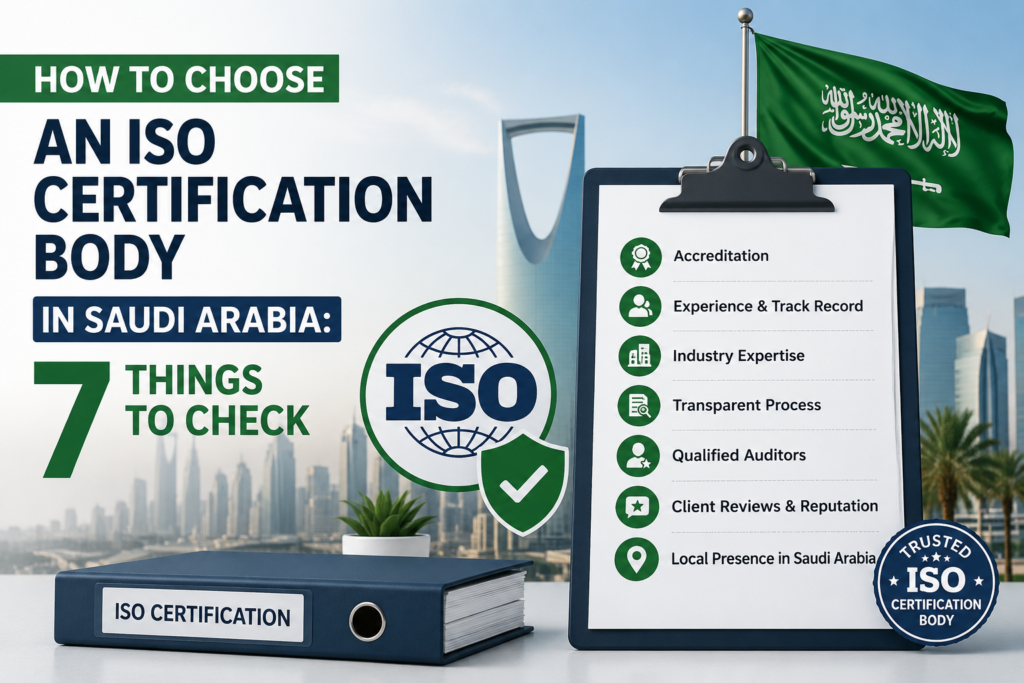
A Riyadh-based logistics company once signed with the first certification body that returned their inquiry email, paid the full fee upfront, and only found out three months later that the body had no SAAC or IAF-recognized accreditation. The certificate was real. It was also useless the moment Etimad’s technical evaluation team checked it. Choosing a certification body is not a decision to rush, and most of what actually matters never makes it into a sales call.
Check Whether the Certification Body Is Actually Accredited
Contents
- 1 Check Whether the Certification Body Is Actually Accredited
- 2 Look for Real Experience in Your Industry
- 3 Confirm a Genuine Local Presence in Saudi Arabia
- 4 Ask What Happens After the Certificate Is Issued
- 5 Insist on Transparent, Itemized Pricing
- 6 Question Timelines That Sound Too Good to Be True
- 7 Ask for Client References You Can Actually Call
- 8 Frequently Asked Questions
- 8.1 What is the single most important factor when choosing an ISO certification body in Saudi Arabia?
- 8.2 How do I know if a certification body’s price is fair?
- 8.3 Should I choose a certification body or an implementation consultant, or does it need to be the same company?
- 8.4 Is a cheaper, faster certification ever worth it?
- 9 Choose a Certification Partner, Not Just a Certificate, with Intellitech
Before anything else, check the certification body against SAAC’s public accredited bodies list, or against IAF CertSearch. Accreditation is what separates a certificate that Aramco, Etimad, and international clients will accept from one that is effectively decoration. The Saudi Accreditation Center, SAAC, is the Kingdom’s national accreditation body, and it has been an IAF Multilateral Recognition Arrangement signatory for management system certification since January 2024, with its recognized scope expanded through 2025 to cover ISO 9001, 14001, 45001, 22000, 13485, 50001, and 27001. A certification body that cannot point you to its current SAAC or equivalent IAF-recognized accreditation status is not automatically fraudulent, but it cannot guarantee your certificate will be recognized where it actually matters, tender technical evaluations, vendor qualification, and international trade.
Look for Real Experience in Your Industry
Ask for the names of standards and sectors the body has certified in the past 12 months, not a general claim of “years of experience.” An auditor who has certified accounting firms and retail shops brings little useful judgment to a petrochemical facility in Jubail or a construction site preparing for Aramco vendor qualification. Industry-specific auditors recognize the operational realities of your sector, hazard patterns in industrial settings, environmental aspects in manufacturing, documentation gaps typical to your business type, rather than applying a generic checklist. Ask directly which industries and which standards the body has recent, verifiable experience certifying.
Confirm a Genuine Local Presence in Saudi Arabia
A consultancy with staff physically based in the Kingdom, not just a regional sales contact, responds faster and understands local tender requirements better than a purely remote provider. Local presence matters for two practical reasons. First, response time: gap analysis visits, document reviews, and pre-audit preparation move faster with a team that can be on-site rather than coordinating across time zones. Second, context: a locally based consultancy understands Etimad tender mechanics, Balady contractor classification, and Aramco or SABIC vendor registration nuances in a way a purely international provider without Saudi-based staff typically does not.
Ask What Happens After the Certificate Is Issued
Confirm in writing whether annual surveillance audits, documentation updates, and recertification support are included or billed separately. ISO certification is a three-year cycle, not a one-time transaction. Certificates require annual surveillance audits to remain valid, and skipping one can suspend the certification entirely. A certification body that disappears after the initial audit leaves you to find, vet, and onboard a new provider under time pressure when the first surveillance audit comes due. Ask specifically what happens in year one and year two after certification, and get the answer in writing before signing.
Insist on Transparent, Itemized Pricing
Get a quote that separately lists the gap analysis, documentation support, Stage 1 and Stage 2 audit fees, and the first year’s surveillance audit, not a single bundled number. The most common source of certification cost disputes is not the headline price, it is what the headline price quietly excludes. Common items left out of an initial quote: annual surveillance audit fees, re-assessment costs if a nonconformity is found during audit, travel or site-visit charges for auditors, and consultant time billed separately from the certification body’s own audit fee. A provider willing to give you a genuinely itemized breakdown, rather than a single round number, is signaling that there is nothing to hide in the fine print later.
Question Timelines That Sound Too Good to Be True
Be skeptical of any provider promising certification in days rather than months, that claim almost always signals an unaccredited certificate. A genuine accredited ISO certificate requires a Stage 1 documentation review and a Stage 2 on-site assessment, and accreditation rules set a minimum audit duration based on company size that cannot be compressed regardless of urgency. Most Saudi businesses complete ISO 9001, 14001, or 45001 certification in 2 to 6 months depending on company size and documentation readiness. A provider promising certification in a week or two is either working with a company that already has a flawless management system in place, which is rare, or issuing a certificate through a body with no real accreditation behind it.
Ask for Client References You Can Actually Call
Case studies and client logos on a website are marketing material. A direct conversation with a past client, ideally one in your industry or facing similar tender requirements, tells you things a case study never will: how responsive the body was when problems came up, whether the promised timeline held, and whether post-certification support actually materialized. A certification body confident in its own track record will not hesitate to connect you with two or three references directly.
Frequently Asked Questions
What is the single most important factor when choosing an ISO certification body in Saudi Arabia?
Accreditation. Everything else, experience, pricing, support, matters only if the underlying certificate is recognized by SAAC or an equivalent IAF-recognized accreditation body. A well-run but unaccredited certification process still produces a certificate that Aramco, Etimad, and international clients may not accept.
How do I know if a certification body’s price is fair?
Compare itemized quotes from three or four accredited bodies rather than a single headline number. Look specifically at what each quote includes: gap analysis, Stage 1 and Stage 2 audits, and the first surveillance audit, so you are comparing the same scope of work across providers.
Should I choose a certification body or an implementation consultant, or does it need to be the same company?
They can be, and often should be, separate. Some organizations use an implementation consultant to build the management system and documentation, then engage a separate accredited certification body to conduct the independent audit, which preserves the auditor’s impartiality.
Is a cheaper, faster certification ever worth it?
Rarely, when the certificate needs to hold up to Aramco vendor registration, Etimad tender evaluation, or international client scrutiny. An unaccredited certificate obtained quickly and cheaply often has to be redone through a properly accredited body once a client or tender actually checks its validity, which costs more in total than doing it correctly the first time.
Choose a Certification Partner, Not Just a Certificate, with Intellitech
Intellitech is an ISO certification consultancy headquartered in Al Jubail, with over 7 years of experience, more than 200 clients, and a team of 45 or more consultants across Saudi Arabia’s Eastern Province, Riyadh, Jeddah, and Al Khobar. We work exclusively with SAAC-accredited and IAF-recognized certification bodies, provide fully itemized pricing before any engagement begins, and stay engaged through every surveillance audit across your three-year certification cycle, not just the initial certificate.


