
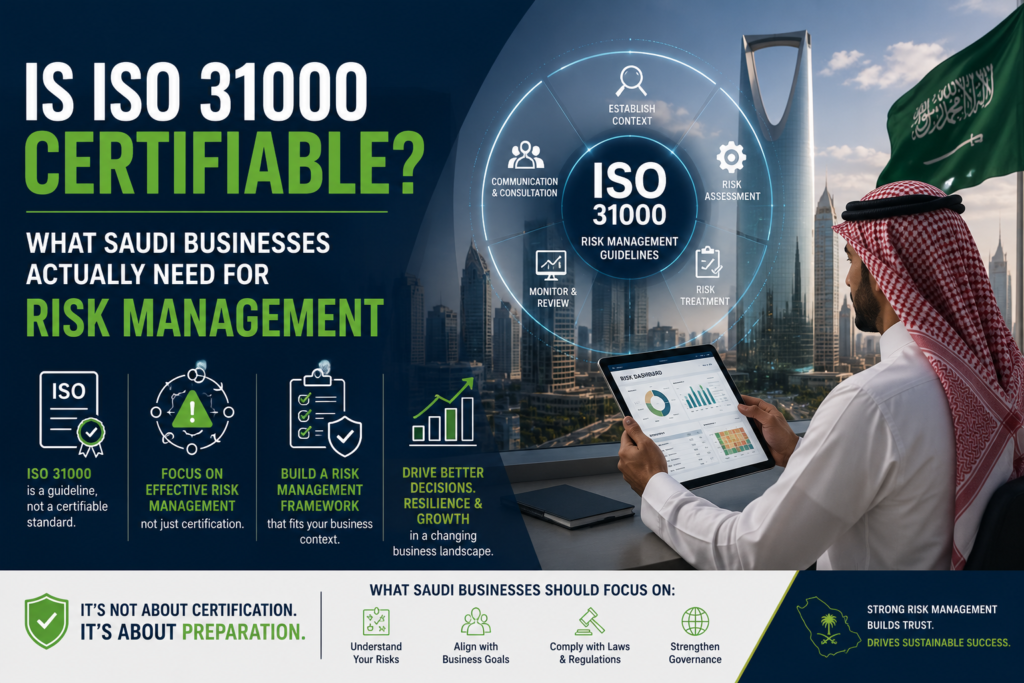
A tender document lists “ISO 31000 certified” as a prequalification requirement. A procurement officer, or a business owner preparing a bid, searches for how to get one. Here is the answer that saves a lot of wasted time: no accredited certification body anywhere in the world, including Saudi Arabia, can issue an ISO 31000 certificate. It is not a certifiable standard, and it never has been.
That single fact trips up more Saudi businesses than almost any other ISO-related confusion, mostly because dozens of providers online advertise “ISO 31000 certification” anyway. Understanding why that offer does not mean what it sounds like will save you money and keep your tender submission accurate.
Why ISO 31000 Is Different From Every Other ISO Standard You’ve Heard Of
Contents
- 1 Why ISO 31000 Is Different From Every Other ISO Standard You’ve Heard Of
- 2 The “ISO 31000 Certification” Offers You’ll See Online Are Not What They Sound Like
- 3 What Saudi Businesses Should Get Instead, Depending on the Actual Requirement
- 4 If You Still Want to Use ISO 31000, Here Is the Honest Path
- 5 Frequently Asked Questions
- 5.1 Is ISO 31000 certifiable?
- 5.2 Why do some companies offer ISO 31000 certification then?
- 5.3 What is the difference between ISO 9001 and ISO 31000?
- 5.4 Which standard should I get if a tender asks for ISO 31000?
- 5.5 Can I check if an ISO 31000 certificate is real or fake?
- 5.6 Does ISO 31000 relate to Saudi Arabia’s Vision 2030 risk management push?
- 5.7 What does an ISO 31000 gap assessment actually involve?
- 6 Get the Standard That Actually Matches Your Requirement
ISO itself states it directly: ISO 31000 provides principles and guidelines for risk management, not a set of auditable requirements. Standards like ISO 9001, ISO 27001, and ISO 45001 contain specific “shall” clauses that an accredited auditor can check off as met or not met. ISO 31000 does not work that way. It describes principles, a framework, and a process for managing risk, deliberately written to be flexible rather than prescriptive, so there is no pass or fail checklist for an auditor to apply.
This was not an oversight. ISO designed it this way on purpose, so that organizations of any size, sector, and risk profile could adapt the guidance to their own context instead of being locked into rigid requirements that make sense for a bank but not for a construction contractor, or vice versa.
The “ISO 31000 Certification” Offers You’ll See Online Are Not What They Sound Like
Here is the part that no Saudi-focused ISO guide addresses directly, and it matters if you have ever seen “ISO 31000 certified” on a company’s website or been quoted a price for it. Some providers issue what they call a “Certificate of Conformity” against ISO 31000. This is a real document, and the assessment behind it may be genuinely useful, but it is not an accredited ISO certification in the sense that ISO 9001 or ISO 27001 certificates are. There is no international accreditation body standing behind an “ISO 31000 certificate” the way the Saudi Accreditation Center (SAC) stands behind a genuine ISO 9001 or ISO 45001 certificate issued in the Kingdom.
This distinction matters for the same reason accreditation matters everywhere else in Saudi ISO certification: a tender board, an Aramco vendor evaluator, or a corporate procurement team checking your certificate against an accredited registry will not find an ISO 31000 certificate there, because none exists. If your business genuinely needs to demonstrate structured risk management to a client or tender board, the credible path is different from what a quick search suggests.
What Saudi Businesses Should Get Instead, Depending on the Actual Requirement
If a tender or client is asking for “ISO 31000 certification,” the underlying need almost always maps to one of these, and each one is a real, accredited, auditable certificate:
- ISO 9001 already requires organizations to apply risk-based thinking throughout the Quality Management System, under Clause 6.1. If the request is really about showing you manage operational and quality risk in a structured way, ISO 9001 covers this and is certifiable.
- ISO 27001 builds its entire structure around a formal information security risk assessment and treatment process. For IT, data-handling, or fintech businesses being asked about risk management specifically around data and systems, this is the accredited standard that actually applies.
- ISO 22301 requires a documented risk assessment and business impact analysis as the foundation of a Business Continuity Management System. If the concern is operational resilience and disaster recovery, this is the certifiable standard built for exactly that.
In practice, a gap analysis quickly reveals which of these actually satisfies the requirement behind the request, and it is almost never a literal search for an “ISO 31000 certificate,” since no such accredited thing exists to search for.
If You Still Want to Use ISO 31000, Here Is the Honest Path
None of this means ISO 31000 is useless. It is a respected, widely referenced framework, and plenty of organizations genuinely benefit from structuring their risk management around it. The honest way to use it is:
- Adopt ISO 31000’s principles and framework internally to shape how your organization identifies, assesses, and treats risk.
- Use it as the risk management backbone that feeds into a certifiable standard like ISO 27001 or ISO 22301, both of which explicitly build on ISO 31000-style risk thinking.
- If a client wants documented proof of alignment, a consultant can prepare a gap assessment report against ISO 31000’s principles. This is a legitimate deliverable, it is just not an “ISO certification” in the accredited sense, and should not be marketed or accepted as one.
Frequently Asked Questions
Is ISO 31000 certifiable?
No. ISO 31000 provides guidelines and a framework for risk management, not auditable requirements, so no accredited certification body can issue an “ISO 31000 certificate.” ISO itself states the standard cannot be used for certification purposes.
Why do some companies offer ISO 31000 certification then?
Some providers issue a “Certificate of Conformity” or similar document after an internal assessment against ISO 31000’s principles. This can be a legitimate advisory deliverable, but it is not backed by international accreditation the way a genuine ISO 9001 or ISO 27001 certificate is, and it should not be presented as equivalent.
What is the difference between ISO 9001 and ISO 31000?
ISO 9001 is a certifiable Quality Management System standard with specific auditable requirements. ISO 31000 is a non-certifiable set of principles and guidelines specifically for risk management. Many organizations use ISO 31000’s framework to strengthen the risk-based thinking already required under ISO 9001’s Clause 6.1.
Which standard should I get if a tender asks for ISO 31000?
Check what the tender is actually trying to verify. If it is general risk-based management, ISO 9001 already covers this. If it is data and information security risk, ISO 27001 is the relevant accredited standard. If it is operational continuity risk, ISO 22301 is built specifically for that.
Can I check if an ISO 31000 certificate is real or fake?
Since no accredited body issues genuine “ISO 31000 certificates,” any document calling itself one cannot be verified against an accreditation registry the way a real ISO 9001 or ISO 45001 certificate can. If verification matters to you, this alone is a signal to look at certifiable standards instead.
Does ISO 31000 relate to Saudi Arabia’s Vision 2030 risk management push?
Yes, indirectly. Enterprise risk management frameworks referenced in Saudi governance and regulatory contexts often cite ISO 31000 as a principles-based benchmark, but the actual certifiable compliance evidence Saudi regulators and corporate clients check for comes through standards like ISO 27001 or ISO 22301, not through ISO 31000 itself.
What does an ISO 31000 gap assessment actually involve?
A consultant reviews how your organization currently identifies, evaluates, and treats risk against ISO 31000’s principles and framework, then produces a report showing where practices align and where gaps exist. It results in a documented assessment, not an accredited certificate.
Get the Standard That Actually Matches Your Requirement
Intellitech has guided 200+ organizations across Saudi Arabia through accredited ISO certification from our Al Jubail base, and part of that work is telling clients honestly when a requested standard, like ISO 31000, cannot be certified at all. A free gap analysis identifies exactly which accredited standard actually satisfies your tender or client requirement, whether that turns out to be ISO 9001, ISO 27001, or ISO 22301.
If you want to understand how to tell a genuinely accredited certificate from one that isn’t, our guide on SAAC-accredited vs non-accredited certification covers exactly that distinction in more depth. And if this came up because of a specific government tender requirement, it’s worth confirming the exact standard requested before assuming ISO 31000 is what’s needed.


