
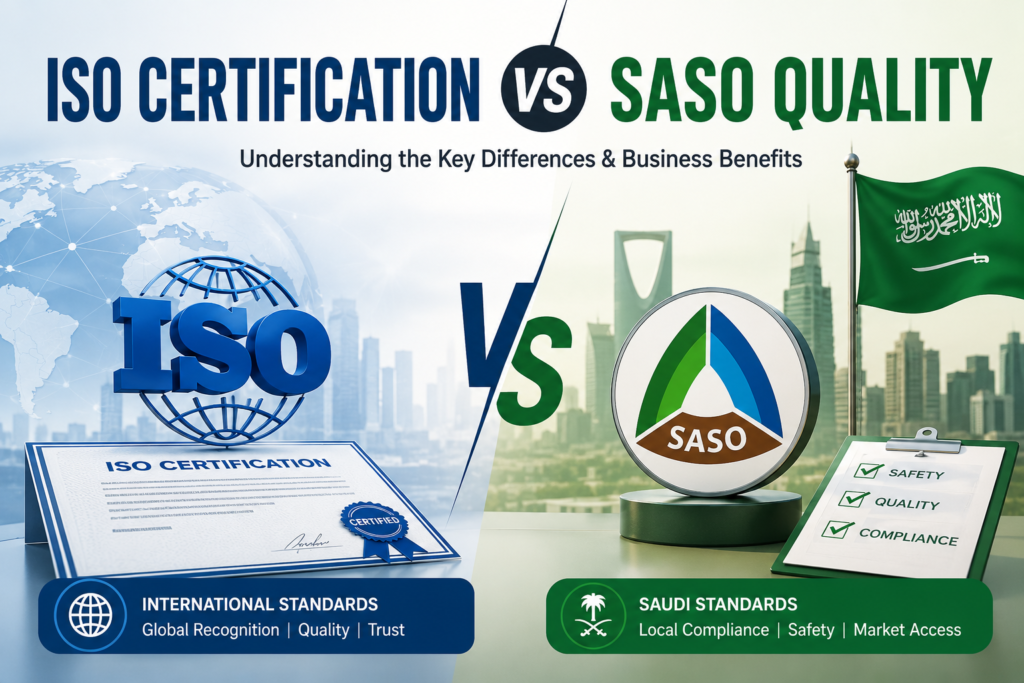
A furniture importer once assumed that because their supplier held an ISO 9001 certificate, their shipment would clear Saudi customs without issue. It didn’t. The container sat at the port for weeks because nobody had registered the product on SABER or obtained a Product Certificate of Conformity. ISO 9001 said nothing about whether the actual product met Saudi Arabia’s technical regulations, because it was never designed to. ISO and SASO are not competing certifications, they answer two different questions, and there is a third layer, the SASO Quality Mark, that almost nothing written on this topic actually explains.
ISO Certifies the Organization, SASO Certifies the Product
Contents
- 1 ISO Certifies the Organization, SASO Certifies the Product
- 2 The Layer Almost Nobody Explains: The SASO Quality Mark
- 3 Decision Matrix: What Your Business Actually Needs
- 4 Cost and Timeline: SABER Moves Faster, ISO Runs Deeper
- 5 Frequently Asked Questions
- 6 Get Clarity on What Your Business Needs from Intellitech
ISO certification, whether ISO 9001, 14001, or 45001, certifies your organization’s management system: documented, repeatable processes for consistent quality, environmental control, or worker safety. It is voluntary under Saudi law, though it functions as a practical requirement for tenders and Aramco or SABIC vendor registration. It says nothing about any specific product you manufacture or import.
SASO, the Saudi Standards, Metrology and Quality Organization, regulates products, not organizations. Under the Saudi Product Safety Program, SALEEM, regulated product categories, electronics, construction materials, toys, cosmetics, food, must be registered on the SABER platform and carry a Product Certificate of Conformity confirming the specific product model meets Saudi technical regulations, plus a Shipment Certificate of Conformity per shipment. Unlike ISO, SASO compliance for regulated products is mandatory. Without it, goods are held or rejected at customs.
The Layer Almost Nobody Explains: The SASO Quality Mark
Most content comparing ISO and SASO stops at the basic Certificate of Conformity. It rarely explains that SASO also issues a distinct, higher tier: the Saudi Quality Mark. A basic CoC confirms the minimum legal threshold for market entry. The Quality Mark is a separate license, granted only when a specific Saudi product standard exists for that category and the manufacturer meets additional technical, and often management system, criteria beyond basic conformity. Its specific commercial purpose is different too: it is built to ease access to government procurement, not simply to clear customs.
This is where the two frameworks actually intersect in a concrete way. Because Quality Mark licensing sits above baseline compliance, the documented quality management evidence ISO 9001 already requires, process control, traceability, corrective action records, directly strengthens a Quality Mark application in a way a company with no formal quality system cannot replicate quickly. A manufacturer with ISO 9001 in place is not just better positioned for tenders in general, it is specifically better positioned for the one SASO credential built around government procurement access. Treating ISO and the Quality Mark as unrelated is the single biggest strategic mistake Saudi manufacturers make when planning certification budgets.
Decision Matrix: What Your Business Actually Needs
| Business Type | ISO Certification | SASO / SABER / Quality Mark |
|---|---|---|
| Manufacturer of regulated physical products | Strengthens tenders and buyer trust | Mandatory CoC; Quality Mark strengthens government procurement access |
| Importer or distributor of regulated products | Optional, boosts vendor credibility | Mandatory for every product model and shipment |
| Service business, no physical product | Needed for tenders and client trust | Not applicable |
| Manufacturer targeting government procurement specifically | Required for technical evaluation scoring | Quality Mark is the specific credential to pursue, not just a basic CoC |
| Contractor supplying regulated equipment or materials | Needed (9001, sometimes 45001) | Applies only to the regulated materials or equipment supplied |
Cost and Timeline: SABER Moves Faster, ISO Runs Deeper
| Process | Typical Timeline | What It Certifies |
|---|---|---|
| ISO 9001 / 14001 / 45001 | 2 to 6 months | Your organization’s management system |
| SABER Product Certificate of Conformity | 5 to 15 working days after testing | One specific product model |
| SASO Quality Mark | Longer than basic CoC; depends on category-specific standard and technical review | Product quality tier above baseline compliance |
These run on separate clocks because they certify separate things. A business is not choosing one process over the other on a timeline basis, both may be required simultaneously for different reasons.
Frequently Asked Questions
Is ISO 9001 a replacement for SASO certification?
No. ISO 9001 certifies your management system. SASO, through SABER, certifies that a specific product meets Saudi technical regulations. Needing one does not remove the requirement for the other.
What is the difference between a basic SASO Certificate of Conformity and the Quality Mark?
A basic CoC confirms minimum mandatory compliance needed to legally sell or import a product. The Quality Mark is a separate, higher-tier license issued only where a specific Saudi product standard exists, and it is built specifically to strengthen access to government procurement.
Does having ISO 9001 help with a SASO Quality Mark application?
Yes, in practice. The documentation, traceability, and process control ISO 9001 already requires overlaps directly with the technical evidence SASO’s Quality Mark licensing expects, which reduces friction that a company with no formal quality system would face starting from zero.
Do service-based businesses need SASO certification?
Generally no. SASO governs physical products. A consulting, IT, or logistics business with no regulated product typically has no SASO obligation, though ISO 9001 still applies for tender eligibility.
How long does SABER registration take compared to ISO certification?
SABER Product Certificates typically take 5 to 15 working days once testing is complete, far faster than ISO certification, which usually takes 2 to 6 months. They are not interchangeable timelines because they certify different things, a product model versus an entire management system.
What happens if I sell a regulated product without SASO certification?
The product is held or rejected at customs, and repeated non-compliance risks fines, storage costs, and damaged trust with distributors. Missing SASO compliance blocks market access outright, regardless of any ISO certification your organization holds.
Get Clarity on What Your Business Needs from Intellitech
Intellitech is an ISO certification consultancy headquartered in Al Jubail, with over 7 years of experience, more than 200 clients, and a team of 45 or more consultants across Saudi Arabia’s Eastern Province, Riyadh, Jeddah, and Al Khobar. We clarify whether your business needs ISO certification, SASO/SABER compliance, the Quality Mark, or a combination, before you spend on the wrong process or miss a mandatory one.
Contact us on +966 59 731 4200, email info@isocertification.com, or visit our consultation page to confirm exactly what your product and organization require.


