
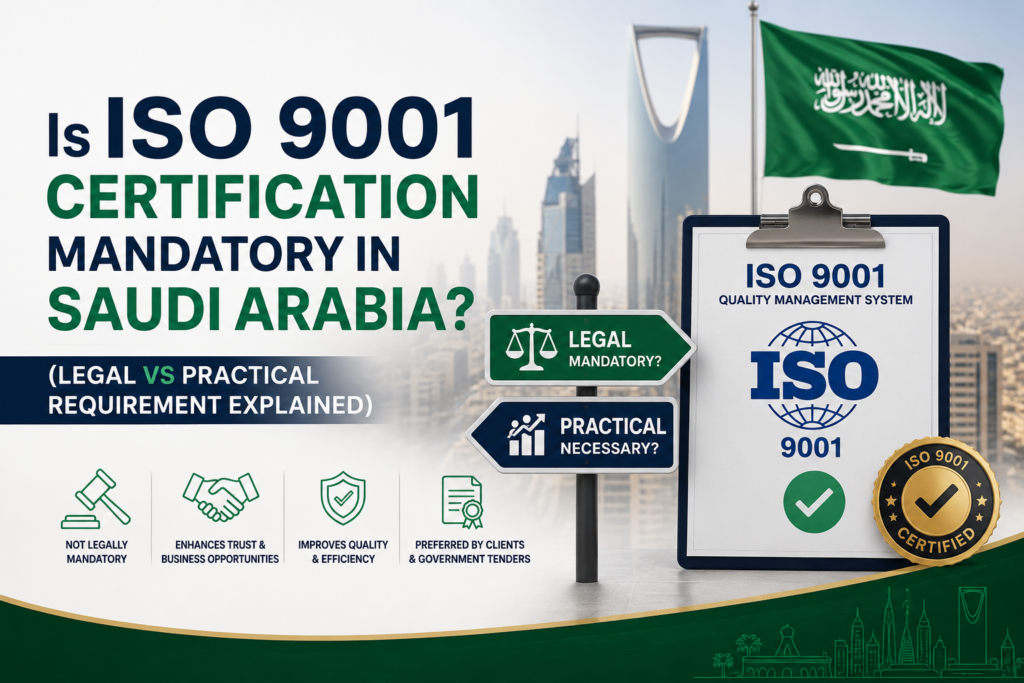
No. There is no Saudi law that says a business must hold ISO 9001 to operate. If you searched for a legal citation making certification compulsory, it does not exist. But if you have ever lost a tender at the technical evaluation stage, or been quietly dropped from an Aramco supplier shortlist, you already know the honest answer is more complicated than a yes or no.
That gap, between what the law requires and what the market requires, is where almost every Saudi business owner gets confused. This article draws the line clearly: where ISO 9001 is genuinely optional, where it is a hard commercial gate, and where the two overlap so completely that “not mandatory” stops being a useful answer.
The legal answer, in one paragraph
Contents
- 1 The legal answer, in one paragraph
- 2 Where ISO 9001 becomes a practical requirement
- 3 Where the line actually sits (and why most guides get this wrong)
- 4 What ISO 9001 certification actually involves
- 5 Who this is most relevant to
- 6 Frequently Asked Questions
- 6.1 Is ISO 9001 legally required to operate a business in Saudi Arabia?
- 6.2 Do I need ISO 9001 to bid on government tenders through Etimad?
- 6.3 Is ISO 9001 mandatory for Aramco or SABIC vendor registration?
- 6.4 Does ISO 9001 affect MOMRAH contractor classification?
- 6.5 How is ISO 9001 different from a legal requirement like GOSI or Zakat registration?
- 6.6 If ISO 9001 is not mandatory, why do most competitors in my sector already have it?
- 6.7 How long is ISO 9001 certification valid, and what happens if it lapses?
- 7 Where does your business actually stand
ISO 9001 is a voluntary international standard published by the International Organization for Standardization. No general Saudi commercial law requires a private company to hold it simply to be licensed or to trade. There is no equivalent of a fire safety certificate or a Zakat clearance where ISO 9001 sits on a mandatory checklist for every business in the Kingdom. Certification bodies, consultancies, and Saudi regulators are consistent on this point: legally, it is not compulsory.
If that were the whole story, this article would end here. It does not, because “not legally mandatory” and “optional in practice” are two different claims, and for most Saudi businesses only the first one is true.
Where ISO 9001 becomes a practical requirement
This is the section most guides skip past with a single sentence. Here is where the practical requirement actually bites, and how hard.
Etimad tenders: technical scoring, not a legal gate
The Etimad platform is Saudi Arabia’s unified electronic system for government procurement, run by the Ministry of Finance since 2018. It is not a law requiring ISO 9001. It is a scoring mechanism, and that distinction matters because it changes how the requirement behaves.
ISO 9001 and ISO 45001 routinely appear in the technical evaluation criteria for tenders across construction, healthcare, logistics, and services. A bid without certification is not automatically disqualified in every case, but it typically receives a lower technical score, and in high-value or prequalification-gated tenders, that can be enough to remove a bidder from consideration entirely before price is even compared. For firms competing on Etimad regularly, the practical effect of not holding ISO 9001 is close to indistinguishable from a legal barrier: you can technically bid, you just rarely win.
Aramco, SABIC, and Eastern Province vendor lists
This is where “practical” turns into something closer to mandatory. Aramco, SABIC, SATORP, and the major EPC contractors operating in Saudi Arabia’s energy sector maintain approved supplier lists, and ISO 9001 (paired with ISO 45001 for anything involving fieldwork) sits as a baseline entry requirement on those lists, not a scoring bonus. For a fabrication, maintenance, or services contractor in Jubail, Dammam, or Al Khobar hoping to work with Aramco or SABIC directly or as a subcontractor, certification is closer to a licence to operate in that supply chain than an optional differentiator.
MOMRAH and contractor classification
Saudi Arabia’s contractor classification system, administered through the Ministry of Municipal and Rural Affairs and Housing (MOMRAH) via the Balady platform, grades construction and contracting firms by technical, financial, and administrative capability. That classification determines the size and value of projects a contractor is legally permitted to bid for. ISO 9001 is not itself a line item the classification law names as mandatory, but a documented quality management system materially strengthens the technical capability assessment that drives your grade, and higher grades unlock higher-value government work. Firms bidding for projects above SAR 100 million face additional MOMRAH technical requirements layered on top, where certified quality systems are increasingly expected as standard practice.
Giga-projects: NEOM, the Red Sea Project, Diriyah
Vision 2030’s flagship developments run their own supplier qualification processes, separate from Etimad and separate from MOMRAH. For firms targeting NEOM or Red Sea Project contracts specifically, ISO 9001 functions as a minimum threshold for even being considered, not a competitive advantage. No published law forces this. The developer’s own procurement policy does.
Private sector and international partnerships
Outside government and giga-project work, large private Saudi corporates and international partners increasingly ask for ISO 9001 as a trust signal before signing supply agreements, particularly where the buyer’s own compliance or ESG obligations require them to demonstrate vetted suppliers. This layer is the softest of the five, and the one where “practical requirement” is closest to genuinely optional.
Where the line actually sits (and why most guides get this wrong)
Most articles answer this question with a flat “not mandatory, but often required for tenders” and stop. That is technically accurate and practically useless, because it treats every Saudi business as if it faces the same exposure. It does not.
The honest way to read your own exposure is by channel, not by a single yes or no:
| Your situation | How close ISO 9001 is to mandatory |
|---|---|
| You bid on Etimad tenders regularly | Very close. Absence directly lowers your technical score and can remove you from contention |
| You are, or want to become, an Aramco or SABIC approved vendor | Effectively mandatory. It is a baseline entry requirement, not a scoring factor |
| You are a contractor seeking a higher MOMRAH classification grade | Strongly influential. Not named explicitly, but materially strengthens your technical capability score |
| You are targeting NEOM, Red Sea Project, or Diriyah supply chains | Effectively mandatory as a qualification threshold, set by the developer, not by law |
| You sell only to Saudi private sector clients with no government or giga-project exposure | Optional, but increasingly expected as a trust signal in competitive bids |
| You operate purely domestically with no tender, vendor list, or classification exposure | Genuinely optional. This is the only category where “not mandatory” is the complete answer |
If you fall into any of the first four rows, the legal answer (“not mandatory”) is technically true and practically irrelevant. Your real question is not whether the law requires it, it is whether your revenue channel does, and for most Saudi businesses reading this, it does.
What ISO 9001 certification actually involves
For businesses in the first four rows above, certification is a project, not a purchase. A quality management system has to be built, implemented, and independently audited before a certificate is issued:
- Gap analysis against your current processes and the ISO 9001:2015 clauses
- Documentation and implementation, building the quality manual, procedures, and records your business actually needs, not a generic template
- Internal audit, checking the system works before an external auditor sees it
- Stage 1 audit, a readiness review by an accredited certification body
- Stage 2 audit, the full assessment against ISO 9001:2015 requirements
- Certificate issuance, valid for three years, with annual surveillance audits to maintain it
A genuine, accredited certification cannot be bought outright. A qualified third-party auditor has to verify your operation in person. Realistic timelines run from roughly 2 to 6 months depending on company size and how developed your existing processes already are, and typical Saudi SME costs range broadly from the low tens of thousands of SAR upward, scaling with company size, number of sites, and current readiness.
Who this is most relevant to
Construction and contracting firms. ISO 9001 is frequently the practical minimum to qualify for construction prequalification, and firms without it are commonly disqualified before price is even discussed.
Aramco, SABIC, and Eastern Province industrial suppliers. The vendor list requirement makes this close to non-negotiable for anyone in the Jubail, Dammam, or Al Khobar industrial supply chain.
Government and semi-government service providers. Any firm bidding regularly through Etimad across healthcare, logistics, facilities management, or professional services is competing directly against certified rivals on technical score.
SMEs planning to scale into tender-based revenue. If government or large corporate contracts are part of your growth plan, certification is worth building before you need it, not after you lose the first bid over it.
Firms that only sell locally, with no tender or vendor list exposure. Certification here is a genuine choice, best evaluated on operational and quality benefits rather than compliance pressure.
Frequently Asked Questions
Is ISO 9001 legally required to operate a business in Saudi Arabia?
No. There is no Saudi commercial law requiring ISO 9001 for general business licensing or operation. It is a voluntary international standard, and legal compliance does not depend on holding it.
Do I need ISO 9001 to bid on government tenders through Etimad?
Not as an absolute legal condition, but in practice, yes for most competitive tenders. ISO 9001 appears in technical evaluation criteria across construction, healthcare, logistics, and services, and its absence typically lowers your technical score or removes you from prequalification lists entirely.
Is ISO 9001 mandatory for Aramco or SABIC vendor registration?
Effectively yes. Aramco, SABIC, and major EPC contractors maintain approved supplier lists where ISO 9001 sits as a baseline requirement, not an optional advantage. Suppliers without it are typically not eligible to register or bid.
Does ISO 9001 affect MOMRAH contractor classification?
It is not named as a direct legal line item in the classification law, but a documented, certified quality management system materially strengthens the technical capability assessment that determines your classification grade, which in turn determines the value of projects you can legally bid for.
How is ISO 9001 different from a legal requirement like GOSI or Zakat registration?
GOSI, Zakat, and Commercial Registration are statutory requirements enforced directly by Saudi law, with legal penalties for non-compliance. ISO 9001 carries no such penalty. Its consequences are entirely commercial: lost tenders, blocked vendor registration, or lower classification, not fines or legal action.
If ISO 9001 is not mandatory, why do most competitors in my sector already have it?
Because for most competitive sectors in Saudi Arabia, tender scoring, vendor list requirements, and classification pressure have made certification a practical necessity even without a legal mandate. Competitors who certified early are winning the technical evaluation points that uncertified bidders are losing.
How long is ISO 9001 certification valid, and what happens if it lapses?
Certification is valid for three years, with annual surveillance audits required to maintain it. If certification lapses, whether through a missed surveillance audit or expiry, you lose immediate access to vendor lists, tender technical scores, and classification benefits tied to it until recertified.
Where does your business actually stand
If you bid on Etimad tenders, supply Aramco or SABIC, or are working toward a higher MOMRAH classification, the honest answer to “is ISO 9001 mandatory” is that your market has already made the decision for you. The remaining question is how fast you can close the gap before the next tender cycle or vendor review.
Intellitech has certified 200+ organisations across Saudi Arabia over 7+ years, with a 45+ consultant bench, from our Al Jubail headquarters in the Eastern Province. We run the gap analysis, tell you exactly where your quality system stands against ISO 9001:2015, and quote a fixed price to close it, no generic templates, no “contact us for a quote” runaround.
Start with a full breakdown of ISO 9001 certification in Saudi Arabia, including current pricing, realistic timelines, and Etimad and Aramco-specific detail. Or book a free gap analysis directly, and call +966 59 731 4200 if you would rather talk it through first.


