
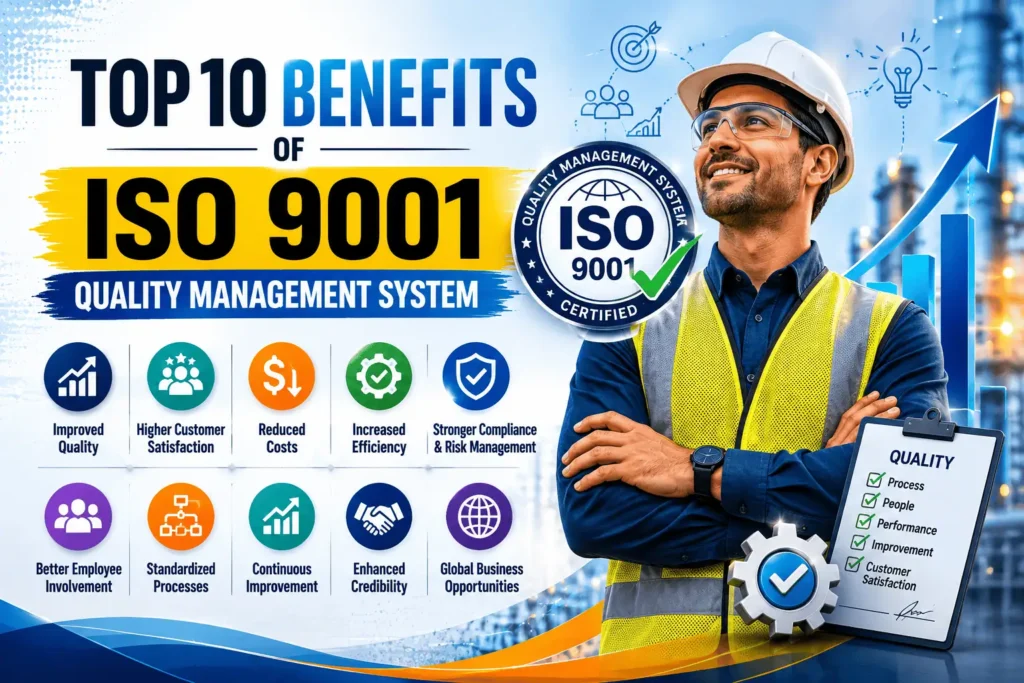
If you have been wondering whether ISO 9001 is actually worth the effort, the short answer is yes and the longer answer is what this blog is about.
ISO 9001 is the world’s most widely adopted quality management standard. More than 1.3 million organizations across 190 countries currently hold certification, and that number keeps growing because the standard delivers real, measurable results for businesses of every size and sector. For companies operating in Saudi Arabia, the case is even stronger. Under Vision 2030, quality management and global compliance are not optional extras. They are core requirements for businesses that want to compete at home and expand internationally.
This guide covers the top 10 benefits of ISO 9001 Quality Management System, explains what each one means in practice, and helps you understand why this certification is one of the most valuable investments a Saudi business can make today.
What Is ISO 9001 Quality Management System?
Contents
- 1 What Is ISO 9001 Quality Management System?
- 2 Why ISO 9001 Matters Specifically for Saudi Businesses
- 3 Top 10 Benefits of ISO 9001 Quality Management System
- 3.1 1. Improved Product and Service Quality
- 3.2 2. Higher Customer Satisfaction
- 3.3 3. Better Operational Efficiency
- 3.4 4. Fewer Operational Errors
- 3.5 5. Stronger Business Reputation
- 3.6 6. Better Employee Performance and Engagement
- 3.7 7. Data-Driven Decision Making
- 3.8 8. Proactive Risk Management
- 3.9 9. Access to More Market Opportunities
- 3.10 10. A Culture of Continuous Improvement
- 4 ISO 9001 Benefits at a Glance
- 5 Industries in Saudi Arabia That Benefit Most from ISO 9001
- 6 ROI of ISO 9001 Certification: What the Numbers Show
- 7 Frequently Asked Questions
- 7.1 What is the main benefit of ISO 9001 certification?
- 7.2 How long does it take to see benefits after ISO 9001 certification?
- 7.3 Is ISO 9001 worth it for small businesses in Saudi Arabia?
- 7.4 Does ISO 9001 apply to service businesses or only manufacturing?
- 7.5 What is the difference between ISO 9001 and ISO 9000?
- 7.6 How often does ISO 9001 certification need to be renewed?
- 8 Final Thought
ISO 9001 is an internationally recognized standard that gives organizations a structured framework for managing quality across their entire operation. It was developed by the International Organization for Standardization and is currently in its 2015 version, with a revision expected in 2026 that will incorporate stronger focus on digital transformation, AI integration, sustainability, and ESG factors.
The standard is built on seven quality management principles: customer focus, leadership, engagement of people, process approach, improvement, evidence-based decision making, and relationship management. Together, these principles shift quality from being a department function to being a core part of how the whole business runs.
What makes ISO 9001 different from a policy checklist is its emphasis on continuous improvement. You do not get certified and stop. You measure performance, identify gaps, make changes, and keep improving. That cycle is what separates businesses that grow year after year from those that plateau.
Why ISO 9001 Matters Specifically for Saudi Businesses
Saudi Arabia is in the middle of a significant economic shift. Vision 2030 is pushing local industries toward international standards, global market access, and higher levels of operational efficiency. Government contracts, large-scale infrastructure projects, and partnerships with foreign investors increasingly require certified suppliers.
Research from 2023 showed Saudi Arabia held over 878,000 active ISO 9001 certificates, reflecting strong national momentum toward quality compliance. Businesses that are certified are positioned to benefit directly from this environment. Those that are not certified are gradually finding themselves excluded from the opportunities that matter most.
Top 10 Benefits of ISO 9001 Quality Management System
1. Improved Product and Service Quality
The most direct benefit of ISO 9001 is exactly what the name suggests: better quality.
When you implement a quality management system, you set clear standards for every product you manufacture or every service you deliver. Your teams know what good looks like, follow documented procedures, and produce consistent output. Defects drop. Rework decreases. Customer complaints fall.
This is not just theory. Research shows that companies with well-defined procedural standards achieve up to a 20 percent improvement in delivery times. When quality is built into the process rather than checked at the end, the whole operation runs better.
For businesses in Saudi Arabia serving international clients or working on large domestic contracts, this level of consistency is not just a nice-to-have. It is often a contractual requirement.
2. Higher Customer Satisfaction
ISO 9001 puts customer requirements at the center of everything. The standard requires you to understand what your customers need, measure how well you are meeting those needs, and take corrective action when you fall short.
The result is a business that genuinely listens and responds. Over time, that builds the kind of loyalty that competitors cannot easily break.
The numbers back this up. Service-based companies that achieved ISO 9001 certification reported a 12 percent increase in customer retention, a 20 percent improvement in customer satisfaction scores, and a 10 percent rise in repeat business. For B2B businesses in Saudi Arabia where relationships and referrals drive growth, these gains are significant.
3. Better Operational Efficiency
ISO 9001 requires you to map and analyze your business processes. Once you look at how work actually flows through your organization, you start to see waste, duplication, and bottlenecks that were invisible before.
Eliminating that inefficiency does not just save time. It reduces costs directly. Manufacturers that implement ISO 9001 effectively typically save between 5 and 10 percent of annual operating costs through reduced waste. Service organizations see similar gains through faster turnaround times and fewer errors in delivery.
A leaner, more organized operation does not just cost less to run. It scales better when business grows and holds up better when demand spikes.
4. Fewer Operational Errors
When every team member follows the same documented procedures, guesswork disappears from daily operations. People know exactly what steps to take, in what order, and to what standard. That consistency reduces human error significantly.
This benefit compounds over time. Each error that does not happen is a customer complaint you do not have to manage, a rework cost you do not have to absorb, and a reputation risk you do not have to recover from. Standardized processes are one of the most practical and underappreciated advantages of ISO 9001 implementation.
5. Stronger Business Reputation
ISO 9001 certification is a globally recognized quality signal. When a potential client, partner, or investor sees that your organization holds this certificate, they immediately understand that you operate to international standards. That recognition carries weight in any market and in any industry.
For Saudi businesses looking to work with international partners, enter new markets, or attract foreign investment, this signal matters enormously. It removes uncertainty from the relationship before it starts. Your brand becomes associated with reliability, and that association compounds over years of consistent delivery.
6. Better Employee Performance and Engagement
One of the less obvious benefits of ISO 9001 is what it does for your workforce.
The standard requires clear documentation of roles, responsibilities, and training requirements for every position. When employees understand exactly what is expected of them, have the skills to do it, and work within a system that makes their job easier rather than harder, performance improves.
Beyond performance, engagement tends to rise as well. People work better in organized environments where accountability is clear and their contribution is visible. ISO 9001 creates that structure. Employee clarity reduces confusion, reduces conflict between departments, and builds a more stable and productive workforce.
7. Data-Driven Decision Making
ISO 9001 requires organizations to measure what matters. You set KPIs, monitor process performance, track customer satisfaction, and review results through regular management reviews.
This changes how leadership teams operate. Instead of making decisions based on gut feeling or anecdotal information, you are working with real data about what is performing, what is not, and where the biggest opportunities lie.
The quality of your decisions improves when they are rooted in evidence. Over time, that advantage accumulates. Businesses that make consistently better decisions outperform their competitors, and ISO 9001 builds the measurement infrastructure that makes that possible.
8. Proactive Risk Management
Every business faces risks. The difference between businesses that handle them well and those that get derailed is preparation.
ISO 9001 builds risk identification into your core processes. You look ahead, spot potential problems before they occur, put controls in place, and build resilience into your operation. This risk-based thinking approach reduces the frequency and severity of disruptions, which directly protects your profitability and your client relationships.
For businesses operating in complex environments such as construction, manufacturing, or regulated industries in Saudi Arabia, this risk management discipline can be the difference between completing a contract successfully and facing costly failures or penalties.
9. Access to More Market Opportunities
This is one of the most commercially significant benefits for growing businesses.
Government contracts, large corporate supply chains, international tenders, and public sector frameworks often require ISO 9001 certification as a minimum entry condition. If you do not hold the certificate, you do not qualify. It is that straightforward.
A single new contract won on the basis of certification can exceed the entire cost of getting certified. Research from the International Trade Centre found that companies implementing ISO 9001 saw an average sales increase of 15 to 20 percent. Independent research confirmed that ISO 9001 certification boosts total sales by an average of 48.3 percent, with the strongest results among small and medium enterprises.
In Saudi Arabia, where Vision 2030 is driving massive investment in infrastructure, healthcare, technology, and tourism, these opportunities are growing rapidly. ISO 9001 certification is one of the clearest ways to ensure your business qualifies.
10. A Culture of Continuous Improvement
Perhaps the most valuable long-term benefit is not any single metric. It is the culture that ISO 9001 builds inside your organization.
When improvement becomes a habit rather than a project, the whole business keeps getting better over time. Teams look for ways to do things more efficiently. Leadership reviews performance and invests in what works. Problems get fixed at the root rather than managed at the surface.
This continuous improvement culture is what makes certified businesses more resilient, more competitive, and more capable over time. It is also what keeps clients coming back, because they consistently experience a business that is improving rather than standing still.
ISO 9001 Benefits at a Glance
| Benefit | What It Delivers |
|---|---|
| Improved product and service quality | Fewer defects, consistent output, reduced rework |
| Higher customer satisfaction | Better retention, loyalty, and repeat business |
| Better operational efficiency | Lower costs, less waste, faster delivery |
| Fewer operational errors | Standardized processes, less guesswork |
| Stronger business reputation | Global recognition, credibility with clients and partners |
| Better employee performance | Clear roles, better training, higher engagement |
| Data-driven decision making | KPI tracking, evidence-based management reviews |
| Proactive risk management | Early problem detection, operational resilience |
| Access to more market opportunities | Government and international contract eligibility |
| Continuous improvement culture | Long-term growth, competitive advantage |
Industries in Saudi Arabia That Benefit Most from ISO 9001
ISO 9001 applies across every sector, but some industries in Saudi Arabia see particularly strong returns from certification.
Construction companies use it to manage project quality, reduce costly rework, and meet client specifications on complex contracts. Manufacturing businesses rely on it to standardize production lines and maintain consistency at scale. Healthcare organizations use it to improve patient safety processes and meet regulatory requirements. Logistics companies apply it to reduce delivery errors and build client confidence. Service businesses from consultancies to IT firms use it to deliver consistent output that keeps long-term clients satisfied.
Whatever your industry, if quality matters to your clients, ISO 9001 is relevant to you.
ROI of ISO 9001 Certification: What the Numbers Show
One of the most common questions about ISO 9001 is whether the investment pays off. The research is clear.
Organizations typically see a payback period of 12 to 24 months as process efficiencies, reduced defects, and new business opportunities start to outweigh the initial cost. Typical ROI reaches 3:1 within 18 months across industries according to ISO Survey data. Manufacturers typically reduce operating costs by 5 to 10 percent annually. Service organizations improve customer retention by up to 15 percent within a year of certification.
Beyond the numbers, access to tenders and contracts that were previously unavailable is often the single biggest financial driver. In markets where certification is a supplier requirement, it is not just an operational investment. It is a commercial necessity.
Frequently Asked Questions
What is the main benefit of ISO 9001 certification?
The main benefit is a consistent, well-managed quality system that improves product and service delivery, increases customer satisfaction, and opens doors to new business opportunities. For most organizations, the commercial benefit of accessing new contracts is the most immediately visible financial return.
How long does it take to see benefits after ISO 9001 certification?
Most organizations begin to see operational benefits within the first few months of implementation as processes become clearer and more consistent. Financial benefits such as new contract wins and reduced rework costs typically materialize within 12 to 24 months.
Is ISO 9001 worth it for small businesses in Saudi Arabia?
Yes. Research shows the strongest sales growth from ISO 9001 implementation is seen among small and medium enterprises. For smaller businesses, certification can be the deciding factor in winning a major contract that transforms the company’s revenue trajectory.
Does ISO 9001 apply to service businesses or only manufacturing?
ISO 9001 applies to any organization regardless of size, sector, or type of output. It is used by manufacturing companies, professional services firms, healthcare organizations, logistics providers, technology companies, and many others. The framework is flexible enough to work across all industries.
What is the difference between ISO 9001 and ISO 9000?
ISO 9000 is the foundational standard that defines the vocabulary and concepts used across the ISO 9000 family of standards. ISO 9001 is the standard that specifies the actual requirements for a quality management system. Organizations get certified to ISO 9001, not ISO 9000.
How often does ISO 9001 certification need to be renewed?
ISO 9001 certificates are valid for three years. During that period, annual surveillance audits are required to maintain the certificate. At the end of the three-year cycle, a full recertification audit is conducted.
Final Thought
ISO 9001 certification is not about paperwork or audit checklists. It is about building an organization that consistently delivers quality, manages risk intelligently, and keeps getting better over time. Those are the foundations of sustainable growth in any market.
For businesses in Saudi Arabia, the case is especially strong right now. The market is demanding certified suppliers, Vision 2030 is reshaping what it takes to compete, and international clients are applying quality requirements that are only going to get stricter.
If you are ready to move forward with ISO 9001 certification in Saudi Arabia, our team at isocertification.me guides businesses through every stage of the process, from initial gap analysis to certification audit. Get in touch today and let us help you build a quality management system that works for your business.


