
A Jeddah-based facilities management company once paid for ISO 14001 certification because a competitor had it, only to discover a year later that none of their actual tenders asked for it, while every single one asked for ISO 45001, which they didn’t have. The certificate on the wall looked good. It did not win a single contract. Choosing between ISO 9001, ISO 14001, and ISO 45001 is not a matter of picking the most impressive-sounding standard, it is a matter of matching the certification to what your specific industry, client base, and regulatory exposure in Saudi Arabia actually require.
The Core Difference in One Line Each
Contents
- 1 The Core Difference in One Line Each
- 2 The Gap Most Comparison Guides Skip: Cost, Timeline, and a Real Saudi Industry Matrix
- 3 The Decision Path: Answer These Questions in Order
- 4 Why an Integrated Management System Usually Beats Separate Certifications
- 5 Frequently Asked Questions
- 6 Get the Right Certification the First Time with Intellitech
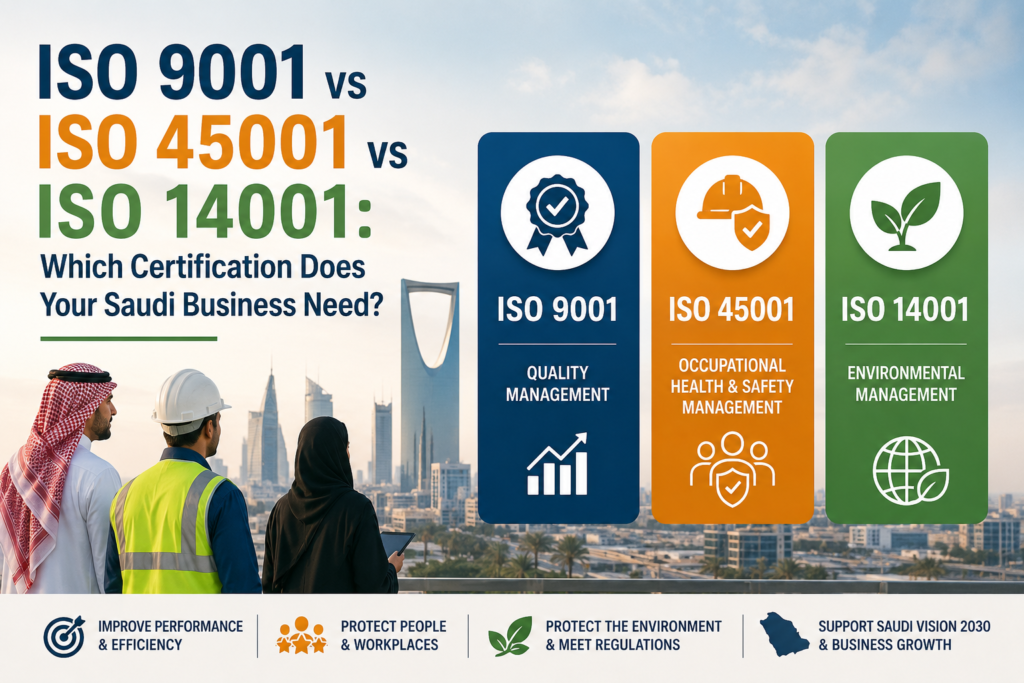
ISO 9001 is a Quality Management System standard. It governs whether your products or services consistently meet what the customer actually ordered. ISO 14001 is an Environmental Management System standard. It governs how your organization identifies and controls its environmental aspects, emissions, waste, resource use, and impacts. ISO 45001 is an Occupational Health and Safety Management System standard. It governs how you identify workplace hazards and manage the risk of injury or illness to your own workers and anyone else present on site.
All three share the same Annex SL high-level structure, the same ten-clause skeleton covering context of the organization, leadership, planning, support, operation, performance evaluation, and improvement. That shared structure is exactly why combining them into a single Integrated Management System is straightforward rather than three unrelated projects bolted together. Where they genuinely differ is the technical content inside that shared skeleton: ISO 14001 runs on an aspects-and-impacts register, ISO 45001 runs on hazard identification and risk assessment, and ISO 9001 runs on process control and customer requirements. Confusing these three technical cores is the single most common reason Saudi businesses either buy a certification they didn’t need or miss one their tenders actually required.
The Gap Most Comparison Guides Skip: Cost, Timeline, and a Real Saudi Industry Matrix
Most articles comparing these three standards stop at dictionary-style definitions. What actually decides a Saudi business’s certification budget and timeline is cost per standard, how long each one takes, and which combination your specific industry and regulator actually expects. Here is that breakdown.
Cost Comparison by Standard
| Standard | Small Business (under 20 employees) | Medium Business (20 to 100 employees) |
|---|---|---|
| ISO 9001 (single standard) | SAR 8,000 to 14,000 | SAR 12,000 to 20,000 |
| ISO 14001 (single standard) | SAR 8,000 to 14,000 | SAR 12,000 to 20,000 |
| ISO 45001 (single standard) | SAR 8,000 to 14,000 | SAR 12,000 to 20,000 |
| All three as an Integrated Management System | SAR 18,000 to 25,000 | SAR 22,000 to 30,000 |
Certifying all three together as an IMS typically costs less than the sum of certifying them separately, since the gap analysis, documentation framework, and internal audit program are shared across all three rather than repeated three times.
Timeline Comparison by Standard
| Standard | Typical Implementation Timeline |
|---|---|
| ISO 9001 | 4 to 6 months from gap analysis to certification audit |
| ISO 14001 | 4 to 6 months, longer if formal environmental permits or emissions monitoring are involved |
| ISO 45001 | 4 to 6 months, longer for high-hazard sites requiring detailed job safety analyses |
| Integrated Management System (all three) | 4 to 6 months, run in parallel rather than sequentially, not three separate 4 to 6 month cycles |
Saudi Industry Recommendation Matrix
| Industry | ISO 9001 | ISO 14001 | ISO 45001 | Why, Specific to Saudi Arabia |
|---|---|---|---|---|
| Oil, gas, and petrochemical (Jubail, Yanbu) | Required | Required | Required | Aramco and SABIC vendor lists expect all three. RCJY’s contractor classification weighs ISO 14001 heavily given emissions and chemical storage exposure across Jubail and Yanbu industrial cities. |
| Construction and EPC | Required | Conditional | Required | ISO 9001 and ISO 45001 sit in most Etimad tender technical evaluations and feed into MOMRAH’s Balady contractor classification. ISO 14001 becomes necessary once a project involves significant earthworks, demolition, or waste disposal. |
| IT, software, and fintech | Required | Not typically needed | Not typically needed | ISO 9001 covers baseline quality expectations, but ISO 27001 is the standard that actually matters here, aligning with NCA cybersecurity requirements and the Personal Data Protection Law. |
| Food and beverage manufacturing | Required | Conditional | Conditional | ISO 9001 pairs with ISO 22000 for SFDA-aligned food safety compliance. ISO 14001 and ISO 45001 become relevant once processing involves significant water discharge, refrigerant handling, or machinery-heavy production lines. |
| Healthcare and medical devices | Required (or ISO 13485 instead) | Not typically needed | Required for clinical or lab settings | Facilities handling patients or lab specimens need ISO 45001 for staff and patient safety exposure, while manufacturers of medical devices generally pursue ISO 13485 in place of ISO 9001. |
| Logistics and warehousing | Required | Conditional | Required | Warehouse and transport operations carry meaningful manual handling and vehicle movement risk, making ISO 45001 a practical necessity, while ISO 14001 matters more for fuel storage and fleet emissions. |
| Hospitality and facilities management | Required | Conditional | Required | Guest and staff safety drives ISO 45001 demand, particularly for Red Sea Global and Vision 2030 tourism developments, while ISO 14001 becomes relevant for water and energy-intensive resort operations. |
The Decision Path: Answer These Questions in Order
Question 1: Do you produce or deliver a product or service to paying customers? If yes, you need ISO 9001. There is no realistic scenario in Saudi Arabia’s tender or vendor-qualification landscape where a business skips ISO 9001 and still competes seriously. Start here regardless of industry.
Question 2: Does your operation generate meaningful environmental impact, emissions, hazardous waste, wastewater, or significant resource consumption? If yes, add ISO 14001. If your business is a professional office, a software company, or a low-impact service provider, ISO 14001 is usually not worth pursuing until a specific client or regulator asks for it.
Question 3: Do your employees, contractors, or site visitors face physical workplace hazards, machinery, chemicals, working at height, vehicle movement, confined spaces? If yes, add ISO 45001. Construction, industrial, logistics, and hospitality operations answer yes almost automatically. A desk-based professional services firm often does not need it unless a specific tender requires it.
Question 4: Do you handle sensitive customer data, run digital infrastructure, or operate in a regulated financial or government-adjacent sector? If yes, your priority certification outside this comparison is information security management certification, typically paired with ISO 9001 rather than ISO 14001 or ISO 45001.
Question 5: Are you in food production, processing, or distribution? Pair ISO 9001 with food safety management certification as your core combination, adding ISO 45001 only if your production floor carries meaningful machinery or manual handling risk.
Why an Integrated Management System Usually Beats Separate Certifications
Once a Saudi business needs two or more of these standards, and most construction, industrial, and oil and gas companies do, certifying them together as one Integrated Management System is almost always the better path. The shared Annex SL structure means Clause 4 through Clause 10 requirements overlap heavily: one management review can cover quality, environmental, and safety objectives together, one internal audit program can rotate through all three scopes, and one set of policies and procedures can reference all three standards rather than maintaining three parallel document sets that inevitably drift out of alignment with each other over time. Saudi contractors that combine ISO 9001, ISO 14001, and ISO 45001 into one IMS consistently report faster surveillance audit cycles and a stronger technical evaluation score on Etimad tenders than those juggling three separate certificates with three separate renewal dates.
Frequently Asked Questions
Do I need ISO 14001 if I don’t handle hazardous materials?
Not necessarily. ISO 14001 is scoped to environmental aspects and impacts, so a low-impact office-based business with minimal waste, emissions, or resource consumption often gets little practical value from it unless a specific client or tender requires it. Businesses with any meaningful industrial footprint should reconsider.
Can I combine ISO 9001, ISO 45001, and ISO 14001 into one certification?
Yes. All three share the same Annex SL high-level structure, which makes combining them into a single Integrated Management System both technically straightforward and typically less expensive than certifying each one separately.
Which ISO standard should a construction company get first?
ISO 9001, since it applies to every sector and appears in nearly every tender’s technical evaluation. ISO 45001 should follow immediately after, since occupational safety carries significant weight in construction-sector prequalification and Balady contractor classification.
Is ISO 45001 mandatory for office-based businesses in Saudi Arabia?
No. ISO 45001 is not a legal requirement for any business type in Saudi Arabia, but it becomes a practical necessity for any organization whose employees face physical workplace hazards, and it is frequently required by clients or tenders in construction, industrial, and logistics sectors specifically.
What is the real technical difference between ISO 14001 and ISO 45001?
ISO 14001 runs on an aspects-and-impacts process that identifies how your organization’s activities affect the environment. ISO 45001 runs on a hazard identification and risk assessment process that identifies what could physically harm workers or site visitors. They share the same management system structure but address entirely different subject matter.
How much does it cost to certify all three ISO standards together?
An Integrated Management System covering ISO 9001, ISO 14001, and ISO 45001 typically costs SAR 18,000 to 30,000 depending on company size, less than pursuing the same three standards as separate certification projects.
Do I need ISO 9001 if I already have ISO 27001 or ISO 22000?
Usually yes, since ISO 9001 covers general quality management while ISO 27001 and ISO 22000 address specific technical domains, information security and food safety respectively. Most Saudi businesses in IT and food sectors pair ISO 9001 with their sector-specific standard rather than substituting one for the other.
Get the Right Certification the First Time with Intellitech
Intellitech is an ISO certification consultancy headquartered in Al Jubail, with over 7 years of experience, more than 200 clients, and a team of 45 or more consultants working across Saudi Arabia’s Eastern Province, Riyadh, Jeddah, and Al Khobar. Before recommending any standard, we run a free gap analysis against your specific industry, client base, and tender requirements, so you certify for what your business actually needs, not what looks impressive on a wall.
Contact us on +966 59 731 4200, email info@isocertification.com, or visit our consultation page to find out which standard, or combination of standards, fits your business.


