
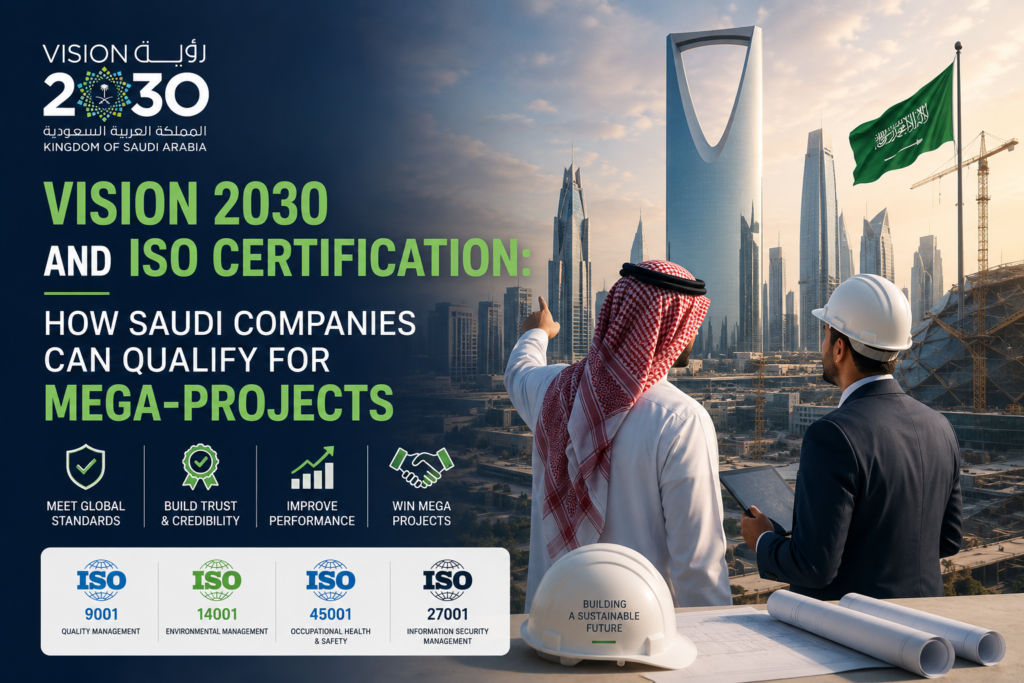
A mid-sized MEP contractor in Dammam submitted its prequalification package to a Red Sea Global vendor portal in early 2026 and was rejected within nine days. The reason had nothing to do with price or capacity. The company had no ISO 45001 certificate on file, and the giga-project’s supplier system flags that as an automatic technical disqualifier before a human reviewer even opens the financial documents. That single missing certificate cost the firm a bid worth several million riyals. This is the reality of doing business with Saudi Arabia’s Vision 2030 programs in 2026: certification is no longer a nice-to-have credential, it is the gatekeeper that decides whether your company’s bid is even read.
Why Vision 2030 Made ISO Certification a Commercial Requirement
Contents
- 1 Why Vision 2030 Made ISO Certification a Commercial Requirement
- 2 The Gap Every Other Guide Skips: RCJY Certification Requirements in Jubail and Yanbu
- 3 Who Needs This: Sector Breakdown
- 4 What Vision 2030 Vendor Portals Actually Require
- 5 The Certification Process for Giga-Project Supplier Qualification
- 6 Certification Costs by Company Size
- 7 Frequently Asked Questions
- 8 Get Certified for Vision 2030 Work with Intellitech
Saudi Arabia’s non-oil economy has expanded faster than overall GDP for three straight years, and giga-projects are the engine behind that shift. NEOM, The Red Sea destination, Diriyah Gate, Qiddiya and ROSHN are collectively valued at more than USD 850 billion, and every one of them runs supplier qualification through a formal vendor portal rather than informal relationship-based procurement. These portals do not evaluate quality claims. They check for certificates on file, and ISO 9001, ISO 45001 and ISO 14001 appear consistently across NEOM, Red Sea Global and Diriyah’s prequalification criteria for contractors, EPC firms and specialist suppliers.
Government and semi-government tenders add a second layer of pressure. Procurement routed through the Etimad platform scores technical submissions partly on certification status, and Aramco, SABIC and major EPC contractors maintain vendor lists where ISO 9001 and ISO 45001 sit as baseline entry requirements, not differentiators. A company chasing Vision 2030 contract value without certification is not competing on a weaker footing. In most cases it is not competing at all.
The Gap Every Other Guide Skips: RCJY Certification Requirements in Jubail and Yanbu
Most articles on Vision 2030 and ISO certification stop at NEOM and the Red Sea. They rarely mention the Royal Commission for Jubail and Yanbu (RCJY), which has run Saudi Arabia’s two largest industrial cities since 1975 and controls contractor and facility registration for one of the densest concentrations of petrochemical, refining and manufacturing activity in the Kingdom, including YASREF and the wider Yanbu refining complex.
RCJY registers contractors and facilities through its unified Yaseer e-services platform, and the Commission has built its own internal operating model around Six Sigma methodology to manage licensing and permitting timelines. Companies working across Saudi Arabia’s oil and gas and petrochemical supply chain encounter this Six Sigma influenced review process most directly. That matters for certification strategy in a specific way: RCJY inspectors and the industrial tenants they regulate, from petrochemical operators to metal fabrication and mechanical engineering firms, increasingly expect ISO 14001 as documented proof of environmental control over emissions, effluent, chemical storage and spill response before a contractor is cleared to work inside Jubail or Yanbu industrial city boundaries. ISO 9001 supports the quality documentation RCJY’s contractor classification process expects, and ISO 45001 covers the occupational safety obligations that come with operating around refining, chemical storage and port logistics.
The practical implication is this: a contractor targeting Vision 2030 mega-project work who is only certified for NEOM or Red Sea Global style vendor portals, and has ignored RCJY’s Jubail and Yanbu registration requirements, has left an entire industrial corridor of eligible work on the table. An integrated ISO 9001, ISO 14001 and ISO 45001 system built around RCJY’s specific contractor classification criteria, not a generic QHSE template, is what actually clears both the Yaseer registration gate and downstream Aramco or SABIC vendor reviews in the Eastern Province. Our Al Jubail industrial city certification guide covers the local registration process in more depth.
Who Needs This: Sector Breakdown
Certification priorities differ by sector and by which giga-project a company is chasing.
- Construction and EPC firms bidding on NEOM’s THE LINE, Trojena or Oxagon, or on Diriyah Gate’s heritage and hospitality build-out, need ISO 9001 and ISO 45001 as a baseline, with ISO 14001 required where environmental disturbance, dust or waste management is part of the scope of work. See our guide on ISO certification for construction companies for sector-specific detail.
- Industrial and petrochemical suppliers operating in RCJY’s Jubail and Yanbu cities need the full ISO 9001, ISO 14001 and ISO 45001 combination, since RCJY contractor classification and Aramco or SABIC vendor qualification both draw on the same certification set.
- Facilities management and logistics providers supporting Red Sea Global’s tourism destinations or Qiddiya’s entertainment district typically need ISO 9001 first, with ISO 14001 following once operational scope expands.
- Manufacturing and fabrication companies supplying components under local content programs such as IKTVA or NUSANED need ISO 9001 to satisfy both giga-project vendor portals and local content verification simultaneously.
What Vision 2030 Vendor Portals Actually Require
Beyond the ISO certificates themselves, giga-project vendor registration typically requires a Commercial Registration certificate, GOSI certification, Zakat and VAT certificates, Chamber of Commerce membership, and, for contractors, a valid government contractor classification. ISO certification sits alongside these as a compliance and regulatory certification item, but unlike a CR renewal, it cannot be produced overnight. A structured ISO 9001, ISO 45001, or ISO 14001 implementation typically takes 4 to 6 months from gap analysis to certification audit when a company starts from no existing documentation, which means firms waiting until a tender is published to begin the process are already too late.
For firms pursuing contracts above SAR 100 million, MOMRAH has also made BIM adoption mandatory, which means ISO 19650 information management certification increasingly sits alongside ISO 9001, 14001 and 45001 as a technical prequalification requirement on larger Vision 2030 construction packages.
The Certification Process for Giga-Project Supplier Qualification
| Step | What Happens | Typical Duration |
|---|---|---|
| 1. Gap Analysis | Review current documentation against the target ISO standard(s) and the specific vendor portal’s technical criteria (NEOM, RCJY, RSG, or Etimad) | 1 to 2 weeks |
| 2. Documentation | Build the management system manual, procedures, risk registers and records the standard requires | 4 to 8 weeks |
| 3. Internal Audit | Test the system against real operating conditions and correct nonconformities before the external audit | 1 to 2 weeks |
| 4. Certification Audit | Accredited certification body conducts Stage 1 and Stage 2 audits and issues the certificate | 2 to 4 weeks |
| 5. Vendor Portal Submission | Upload certificates to the relevant giga-project or Etimad vendor system alongside CR, GOSI, Zakat and VAT documentation | Ongoing |
Certification Costs by Company Size
| Company Size | Single Standard (e.g. ISO 9001) | Integrated System (ISO 9001 + 14001 + 45001) |
|---|---|---|
| Small (under 20 employees) | SAR 8,000 to 14,000 | SAR 18,000 to 25,000 |
| Medium (20 to 100 employees) | SAR 12,000 to 20,000 | SAR 22,000 to 30,000 |
| Large (100+ employees, multi-site) | SAR 18,000 to 28,000 | SAR 28,000 to 35,000 |
These figures cover both the consultancy fee and the certification body’s audit fee. Intellitech quotes fixed prices after a free initial gap analysis, so there are no open-ended engagements or surprise costs once the scope is defined.
Frequently Asked Questions
Is ISO certification legally mandatory to bid on Vision 2030 projects?
ISO certification is not a legal requirement under Saudi law, but it functions as a practical requirement. NEOM, Red Sea Global, Diriyah Gate and government tenders routed through Etimad all use certification status as a technical scoring criterion or an outright prequalification gate, so in commercial terms it operates as mandatory for any company competing seriously for giga-project or government contracts.
Which ISO standard should a construction company get first for giga-project bids?
ISO 9001 is the logical starting point because it applies across every sector and appears most frequently in vendor portal requirements. Companies bidding on construction, industrial or high-risk work should follow immediately with ISO 45001, since occupational safety certification carries the most weight in technical evaluation for that sector.
Do RCJY-registered contractors in Jubail and Yanbu need different certification than NEOM suppliers?
The core standards overlap, ISO 9001, 14001 and 45001 apply in both cases, but RCJY’s contractor classification and Yaseer registration system places heavier weight on ISO 14001 given the environmental exposure of petrochemical and refining operations in Jubail and Yanbu, while NEOM’s construction-heavy vendor base leans more on ISO 45001 for site safety.
How long does it take to get ISO certified before a giga-project tender deadline?
A structured implementation typically takes 4 to 6 months from a standing start with no existing documentation, or 30 to 60 days for companies that already have documented processes in place. Waiting until a tender notice is published is usually too late to certify in time.
Does ISO 19650 replace ISO 9001 for construction bids over SAR 100 million?
No. ISO 19650 covers BIM information management specifically and is an additional MOMRAH-driven requirement for large construction packages. It sits alongside ISO 9001, 14001 and 45001 rather than replacing any of them.
Can a small subcontractor with fewer than 20 employees realistically get certified for Vision 2030 work?
Yes. ISO standards are scalable by design, and a small subcontractor can scope its management system tightly around its actual operations rather than adopting the documentation burden of a large multi-site enterprise, which keeps both cost and timeline proportionate.
Does an Integrated Management System give a stronger prequalification score than separate certificates?
Yes. Contractors that combine ISO 9001, 14001 and 45001 into a single Integrated Management System report stronger prequalification scores and shorter tender evaluation cycles than those managing three separate, uncoordinated certificates, largely because the governance picture presented to reviewers is unified rather than fragmented.
Get Certified for Vision 2030 Work with Intellitech
Intellitech is an ISO certification consultancy headquartered in Al Jubail with over 7 years of experience, more than 200 clients and a team of 45 or more consultants across Saudi Arabia’s Eastern Province, Riyadh, Jeddah and Al Khobar. We build ISO 9001 quality management certification programs, occupational health and safety management systems under ISO 45001, and environmental management certification through ISO 14001 around the specific vendor portal or regulator, whether that is NEOM, Red Sea Global, RCJY’s Yaseer platform, or Etimad, that your business needs to clear.
Our fixed-price gap analysis identifies exactly which standards your target giga-project requires before you commit to a scope. Contact us on +966 59 731 4200, email info@isocertification.com, or visit our consultation page to book a free assessment.


