
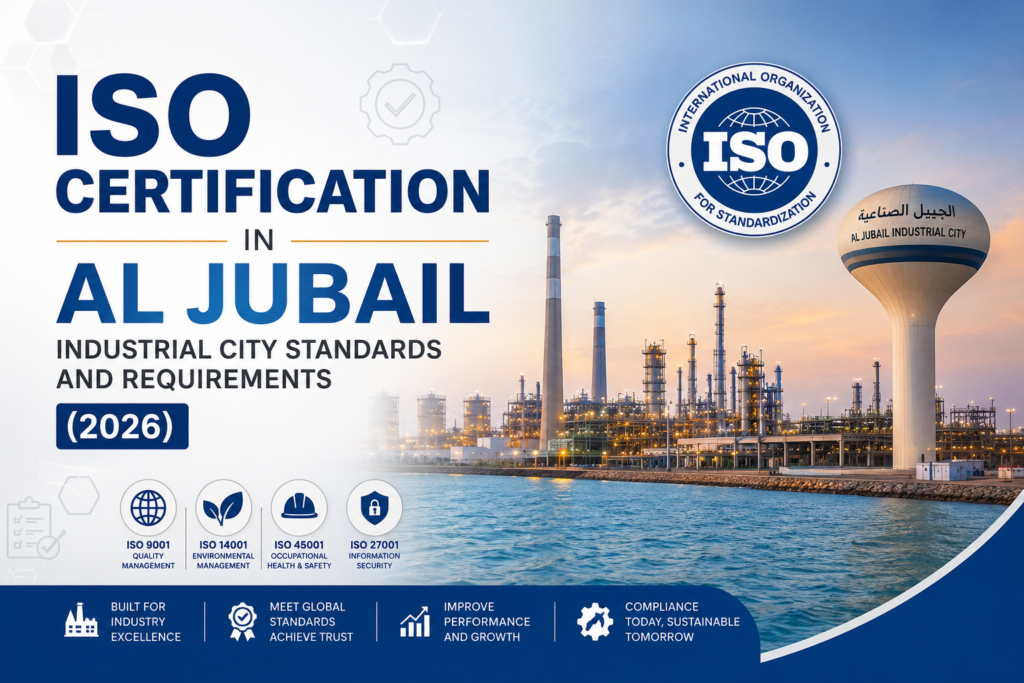
Intellitech is based in Al Jubail, and ISO certification Al Jubail is the environment we know best. Not because it is a convenient location on a map, but because Jubail is where the most demanding ISO certification requirements in Saudi Arabia concentrate in one place.
Jubail Industrial City is one of the largest industrial cities in the world. It hosts over 150 petrochemical and chemical plants, connected by an integrated pipeline and utilities network managed by the Royal Commission for Jubail and Yanbu (RCJY). Saudi Aramco, SABIC, SADARA, SIPCHEM, TASNEE, MARAFIQ, and dozens of joint ventures between Saudi organizations and international companies from the US, Europe, Japan, and South Korea all operate here. Saudi petrochemical exports from Jubail and the wider industrial zone reached approximately USD 45 to 50 billion in 2025.
Every one of those major operators maintains a vendor qualification process. Every one of those processes has ISO certification built into it. ISO certification Al Jubail is therefore not a standalone quality initiative. For the hundreds of small and medium businesses in Al Jubail’s supply chain, whether they are mechanical contractors, maintenance service providers, inspection companies, logistics operators, or industrial equipment suppliers, ISO certification is not a growth ambition. For businesses across Jubail Industrial City, ISO certification Al Jubail is the minimum requirement to get into the conversation.
Why ISO Certification Requirements Are Different in Al Jubail
Contents
- 1 Why ISO Certification Requirements Are Different in Al Jubail
- 2 Which ISO Standards Al Jubail Businesses Need
- 3 RCJY Projects and ISO as a Tender Prerequisite
- 4 What RCER-2025 Means for Al Jubail Companies
- 5 The Jubail Supply Chain: Why Tier-Two Certification Matters
- 6 The Certification Process and Timeline
- 7 ISO Certification Cost in Al Jubail
- 8 Frequently Asked Questions
- 8.1 Do all companies in Jubail Industrial City need ISO certification?
- 8.2 Which certification body is recognized by Aramco and SABIC in Jubail?
- 8.3 Can a Jubail company certify ISO 9001 and ISO 45001 at the same time?
- 8.4 Does RCJY accept the same ISO certification that Aramco requires?
- 8.5 How long does ISO certification take in Al Jubail?
- 9 ISO Certification in Al Jubail with Intellitech
Most Saudi cities have ISO certification requirements driven by government procurement through Etimad and by general commercial expectations. Al Jubail has all of that, and a layer on top of it that does not exist anywhere else in the Kingdom.
RCJY as regulator and client simultaneously. The Royal Commission for Jubail and Yanbu is an independent authority separate from MODON. It develops and manages Jubail Industrial City, Yanbu Industrial City, and Ras Al Khayr, focusing specifically on heavy industry, petrochemicals, refining, and mining. RCJY has its own engineering standards, its own environmental regulations (RCER-2025), its own permitting system, and its own vendor and contractor qualification processes for projects within the industrial city boundary. Companies tendering for RCJY-managed projects face certification requirements from the Commission itself, independently of what Aramco or SABIC require.
International joint venture standards. Jubail’s petrochemical complexes include joint ventures between Saudi organizations and multinational companies. These international partners apply their home-market standards to local operations. A German-Saudi joint venture in Jubail applies the same QMS expectations it would apply in Germany. An American-Saudi plant follows the same vendor qualification criteria it uses in Texas. ISO 9001 and ISO 45001 are not differentiators in this environment. They are the price of entry into the supply chain.
SABIC’s vendor registration. SABIC, now an Aramco subsidiary, maintains one of the most structured vendor qualification processes in the region. Its standards apply across its Jubail affiliates including SABIC Agri-Nutrients, Ibn Rushd, Petrokemya, and others. The baseline qualification requirement for physical operations categories includes quality management certification and occupational health and safety certification. Getting onto the SABIC approved vendor list without ISO 9001 and ISO 45001 in place is not realistic.
SPARK industrial zone. Saudi Aramco’s SPARK (Special Integrated Logistics Zone) is a dedicated industrial zone in the Eastern Province developed by Aramco targeting oil and gas services, petrochemicals, and renewable energy companies. SPARK operates under its own regulatory framework, separate from MODON and RCJY. Companies establishing in SPARK face Aramco-derived vendor qualification requirements from day one of operations.
Which ISO Standards Al Jubail Businesses Need
When it comes to ISO certification Al Jubail, the answer depends on your sector and your key clients, but the patterns in Jubail are more consistent than in other Saudi cities.
Quality management certification is the universal starting point. Every company in Jubail’s supply chain that wants to qualify with Aramco, SABIC, RCJY project contractors, or any major industrial operator needs a structured quality management system. ISO 9001 is what most clients recognize and require. For companies in the oil and gas supply chain specifically, some Aramco vendor categories require ISO 29001, the sector-specific extension of ISO 9001 for petroleum and petrochemical operations, rather than ISO 9001 alone. Verify your specific category requirements in the SAPS prequalification form before choosing your standard.
Learn more about ISO 9001 certification in Saudi Arabia.
Occupational health and safety certification is effectively required alongside quality certification for any company with physical operations in Jubail. Worker safety in industrial environments is not a suggestion. Aramco’s contractor safety requirements, SABIC’s HSE vendor qualification criteria, and RCJY’s operational standards all treat ISO 45001 as a baseline. For construction, maintenance, inspection, and industrial services companies operating inside the Jubail industrial city fence, the combination of ISO 9001 and ISO 45001 is what opens the door to work.
See how ISO 45001 connects to Aramco vendor qualification.
Environmental management certification has moved from optional to commercially expected for most Jubail industrial companies. RCER-2025, the Royal Commission Environmental Regulations for industrial cities, applies to all operations within Jubail, Yanbu, and Ras Al Khayr. Environmental compliance in Jubail’s petrochemical environment is under continuous monitoring from RCJY’s environmental department. Major clients including SABIC and Aramco report against ESG frameworks that place environmental performance requirements on their supply chains. ISO 14001 provides the management system that makes environmental compliance demonstrable and that satisfies the ESG-linked requirements now appearing in supply chain qualification processes.
Explore ISO 14001 environmental management certification.
Integrated Management System (IMS). The combination of ISO 9001, ISO 14001, and ISO 45001 in a single governance framework is increasingly the standard for serious industrial contractors in Jubail rather than the exception. Certifying all three together costs significantly less than certifying them sequentially, and the resulting system satisfies quality, safety, and environmental requirements in a single audit cycle. For companies pursuing Aramco and SABIC vendor qualification simultaneously, an IMS is both the most efficient and the most commercially complete approach.
Learn about Integrated Management System certification.
RCJY Projects and ISO as a Tender Prerequisite
The Royal Commission manages significant ongoing capital project activity in Jubail Industrial City, including infrastructure expansion, utility upgrades, and new industrial plot development. Contractors bidding on RCJY-managed projects encounter ISO certification requirements in the prequalification documentation in two ways.
First, as a direct document requirement: ISO 9001 and ISO 45001 certificates are listed as required submission documents in most RCJY contractor prequalification applications. An incomplete submission does not advance.
Second, as part of the technical scoring: In evaluated bids, certified contractors score higher on quality and safety management criteria than uncertified competitors. In a competitive tender environment where pricing is tight, the technical score difference between a certified and uncertified company can determine the outcome.
For companies headquartered in Al Jubail or elsewhere in the Eastern Province that are building their RCJY project pipeline, ISO certification is a direct enabler of bid eligibility, not a peripheral credential.
What RCER-2025 Means for Al Jubail Companies
All companies operating within Jubail Industrial City, Yanbu Industrial City, and Ras Al Khayr industrial zones must comply with the Royal Commission Environmental Regulations (RCER-2025) in addition to national NCEC requirements. RCER-2025 covers air quality standards, wastewater discharge limits, hazardous waste management, noise control, and environmental monitoring requirements specific to industrial city operations.
ISO 14001 does not replace RCER-2025 compliance. What it does is create the management system infrastructure through which RCER-2025 obligations are tracked, monitored, and maintained. Companies with an ISO 14001 certified Environmental Management System have documented their environmental aspects and impacts, maintain a legal register that includes RCER-2025 requirements, monitor environmental performance continuously, and have corrective action procedures ready when monitoring reveals deviations.
Companies without ISO 14001 often discover RCER-2025 compliance gaps when an RCJY environmental inspector arrives. Companies with ISO 14001 in place find inspections significantly more straightforward because the documentation and monitoring records the inspector expects are already produced as a routine part of the management system.
The Jubail Supply Chain: Why Tier-Two Certification Matters
Many small businesses in Al Jubail assume ISO certification requirements apply only to the tier-one contractors working directly with Aramco or SABIC. The reality is that certification requirements cascade down the supply chain.
A tier-one EPC contractor with Aramco qualification applies the same vendor criteria to its subcontractors that Aramco applies to it. A SABIC affiliate requires its maintenance service provider to hold ISO 9001 and ISO 45001. That maintenance company, in turn, requires its inspection subcontractor to demonstrate equivalent certification. By the time the requirement reaches a 15-person inspection or testing company, it has come down three tiers from the original industrial operator.
For SMEs in Al Jubail’s supply chain, this means ISO certification requirements are real regardless of whether you have ever dealt directly with Aramco or SABIC. The question is whether your direct clients require it from you. In Jubail’s industrial environment, the answer is almost always yes.
The Certification Process and Timeline
For Al Jubail businesses, the certification process follows the same structure as elsewhere in Saudi Arabia: gap analysis, documentation development, training, internal audit, management review, and certification audit. What differs is the context.
Gap analyses in Jubail frequently reveal that companies have strong informal safety and quality practices, built up over years of operating in demanding industrial environments, but minimal formal documentation. The operational knowledge exists. The system does not. This baseline actually makes implementation faster: building documentation around existing good practice is significantly quicker than developing processes from scratch.
Timeline expectations for Al Jubail businesses:
| Starting point | ISO 9001 only | ISO 9001 + ISO 45001 | Full IMS (9001+14001+45001) |
|---|---|---|---|
| Minimal documentation | 45 to 60 days | 60 to 75 days | 75 to 95 days |
| Existing documented processes | 30 to 45 days | 45 to 60 days | 55 to 75 days |
ISO Certification Cost in Al Jubail
Costs for Al Jubail businesses are consistent with Eastern Province ranges. Single standard certification for most SMEs falls between SAR 10,000 and SAR 30,000 depending on company size, number of sites, and industry risk level. High-risk industrial categories (construction, maintenance, inspection) and multi-site organizations sit toward the higher end.
Intellitech provides fixed-price quotations after a free gap analysis. The first conversation tells you exactly where you stand and what certification will involve for your specific operations.
Frequently Asked Questions
Do all companies in Jubail Industrial City need ISO certification?
Any company seeking to qualify as a vendor or contractor to Aramco, SABIC, RCJY projects, or major EPC contractors in Jubail effectively needs ISO certification. Smaller companies operating purely in commercial sectors without industrial clients may not face the same requirement, but the majority of Jubail’s business community is connected to the industrial supply chain.
Which certification body is recognized by Aramco and SABIC in Jubail?
Both organizations require certification from IAF-accredited certification bodies. Aramco’s SAPS prequalification process verifies accreditation status directly. Submit certificates from bodies that are IAF-accredited and verify recognition with Aramco’s SAPS system for your specific vendor category before proceeding.
Can a Jubail company certify ISO 9001 and ISO 45001 at the same time?
Yes. Integrated implementation is the standard approach for Jubail industrial companies. The two standards share significant structural overlap and certifying them together costs substantially less than certifying them sequentially.
Does RCJY accept the same ISO certification that Aramco requires?
Yes. ISO 9001 and ISO 45001 certificates from IAF-accredited bodies are accepted by both RCJY prequalification processes and Aramco SAPS. The same certificates serve both requirements.
How long does ISO certification take in Al Jubail?
With professional consultancy support, most Al Jubail SMEs certify ISO 9001 in 30 to 45 days if they have existing documented processes, or 45 to 60 days starting from minimal documentation. Combined ISO 9001 and ISO 45001 typically takes 60 to 75 days.
ISO Certification in Al Jubail with Intellitech
Intellitech is headquartered in Al Jubail’s Al Dana District, at the center of the Eastern Province’s industrial ecosystem. The team has supported Jubail-based contractors, maintenance companies, inspection firms, logistics operators, and industrial service providers through ISO 9001, ISO 45001, ISO 14001, and Integrated Management System certifications for over seven years.
Understanding what RCJY project prequalification requires, what Aramco SAPS evaluators look for, and what RCER-2025 environmental compliance demands from an ISO 14001 implementation is not general knowledge. It comes from working in this specific environment consistently. That is the practical difference between Intellitech and a consultancy working from Riyadh or Jeddah.
ISO 9001 Certification | ISO 45001 Certification | ISO 14001 Certification | Integrated Management System | Get a Free Consultation
+966 59 731 4200 | info@isocertification.com | Madina Al Munawarah Street, Al Dana District, Al Jubail 35514


