
Most Saudi businesses that start looking into ISO certification ask the same question early: how long is this going to take, and what actually has to happen?
It is a fair question. The process has real structure to it, and knowing what each stage involves, and why it exists, makes the whole thing significantly less daunting. It also helps you make smarter decisions about timing, especially if you have a tender deadline, a client requirement, or a Vision 2030 project prequalification coming up.
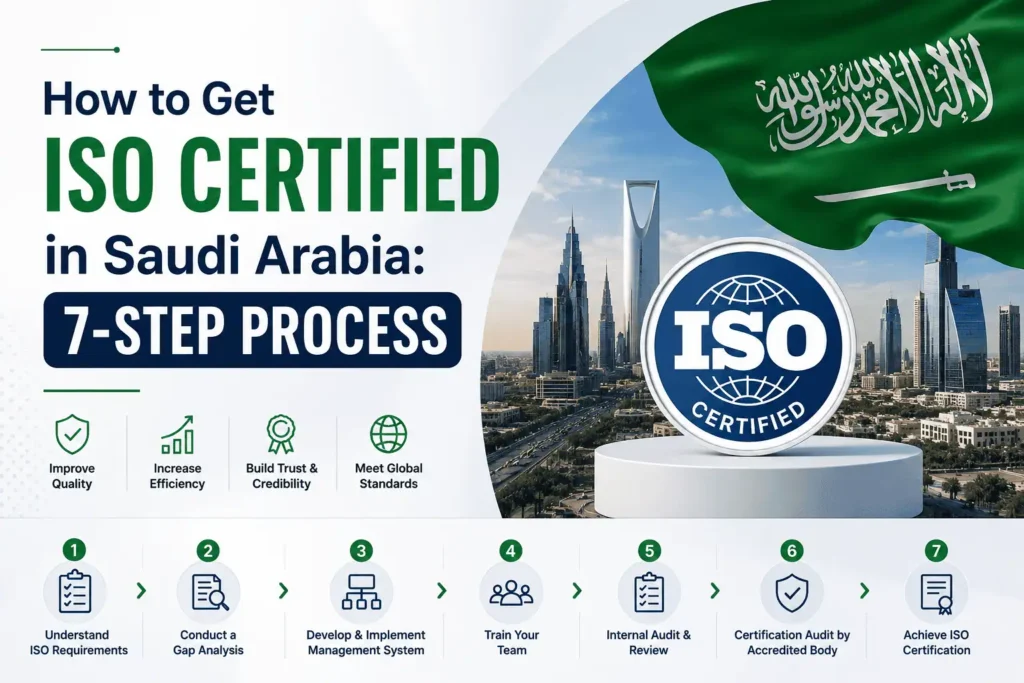
This guide walks through the complete 7-step process for getting ISO certified in Saudi Arabia, with realistic timeline expectations for each major standard and the specific points where Saudi businesses commonly hit delays.
Before You Start: Choosing the Right ISO Standard
Contents
- 1 Before You Start: Choosing the Right ISO Standard
- 2 The 7-Step ISO Certification Process in Saudi Arabia
- 3 Realistic ISO Certification Timeline by Standard
- 4 What Happens If You Fail the Certification Audit
- 5 Frequently Asked Questions
- 5.1 How much does ISO certification cost in Saudi Arabia?
- 5.2 Can I get ISO certified without a consultant in Saudi Arabia?
- 5.3 Does ISO certification need to be in Arabic in Saudi Arabia?
- 5.4 Which certification body is best in Saudi Arabia?
- 5.5 Do I need a separate ISO certificate for each office location in Saudi Arabia?
- 6 Get ISO Certified in Saudi Arabia with Intellitech
The certification process is largely the same across ISO standards. The differences are in what you are documenting, who you are training, and what an auditor will look for on-site. Choosing the right standard first means you are building the right system, not rebuilding it later.
Here is a quick reference for the most common certifications Saudi businesses pursue:
ISO 9001 covers quality management. Required for most government tenders through Etimad, Aramco and SABIC vendor qualification, and a baseline requirement for almost every sector. If you are unsure which standard to start with, this is almost always the answer.
ISO 45001 covers occupational health and safety. Required alongside ISO 9001 for construction, industrial, and energy sector work. Critical for Eastern Province supply chain companies and anyone working within Jubail Industrial City or NEOM-related project scope.
ISO 14001 covers environmental management. Increasingly required in petrochemical, manufacturing, and construction sectors, particularly for companies with SFDA, NCEC, or ARAMCO environmental compliance requirements.
ISO 27001 covers information security. Required or strongly recommended for technology companies, financial services firms, healthcare organizations, and any business handling data under Saudi Arabia’s Personal Data Protection Law (PDPL).
ISO 22000 covers food safety management. Required for food manufacturers, processors, distributors, and hospitality businesses working with major Saudi retailers or export markets.
Not sure which standard applies to your business? Request a free consultation here.
The 7-Step ISO Certification Process in Saudi Arabia
Step 1: Gap Analysis
What happens: A gap analysis is a structured review of your current operations against the requirements of the ISO standard you have chosen. It goes clause by clause through the standard, comparing what exists in your organization now against what the standard requires.
The output is a prioritized action list: what documentation you already have that counts, what needs to be developed from scratch, what processes exist informally and need to be formalized, and where your biggest risks are before the certification audit.
Why it matters: Skipping the gap analysis is the most common reason Saudi businesses hit unexpected delays during certification. Without it, implementation is guesswork. You might spend three weeks building procedures for processes that are already compliant, while missing a critical record-keeping requirement that triggers a major non-conformity at the audit stage.
A good gap analysis takes one to three days depending on company size. For most Saudi businesses, it reveals that 40 to 60 percent of what the standard requires is already in place in some form. The work is in formalizing it, not starting from zero.
Typical duration: 1 to 3 days.
Step 2: Build and Implement Your Management System
What happens: Based on the gap analysis findings, your team builds the documented management system the chosen ISO standard requires. This is the largest body of work in the entire process.
For ISO 9001, this typically includes a quality manual, quality policy, quality objectives, context of the organization analysis, stakeholder register, risk and opportunity register, process maps for core operational activities, standard operating procedures for key processes, and templates for the records the standard requires.
For ISO 45001, additional documentation includes a health and safety policy, hazard identification and risk assessment records, legal register covering Saudi labor law and Ministry of Human Resources health and safety regulations, emergency preparedness procedures, incident investigation templates, and contractor safety management procedures.
The critical point most implementations miss: Documents must reflect how your organization actually operates. Auditors do not just read procedures. They interview employees and follow records back to real activities. A set of procedures copied from a template that your team has never read will produce non-conformities regardless of how well-formatted the documents are.
Typical duration: 2 to 5 weeks depending on organization size, number of sites, and how much relevant documentation already exists.
Step 3: Train Your Team
What happens: Everyone involved in the management system needs to understand their role within it. This is not a company-wide awareness session. It is targeted training that links specific people to specific responsibilities within the documented system.
Training must be documented. ISO standards require competence records: evidence that relevant personnel have received training and demonstrated understanding of their responsibilities. Auditors will ask employees questions. If your quality manager can explain the system but your operations supervisor has never heard of the internal audit schedule, that is a finding.
For Saudi companies, there are a few additional practical points. If your workforce includes a significant proportion of non-English-speaking employees, operational procedures they are responsible for following should be accessible in Arabic. Auditors observe actual operations. A procedure that exists only in English in a workplace where operations staff work in Arabic creates a real compliance gap, not a theoretical one.
Typical duration: 1 to 2 weeks. Often runs in parallel with documentation development.
Step 4: Run Your Internal Audit
What happens: The internal audit is a full review of your management system against the ISO standard, conducted by someone in your organization who has been trained as an internal auditor. It is a dress rehearsal for the certification audit, and it is a mandatory requirement of every ISO standard.
The internal audit covers every clause of the standard and every area of the organization within the certification scope. The auditor interviews staff, reviews records, and documents findings. Non-conformities must be recorded, investigated, root causes identified, corrective actions implemented, and evidence of closure maintained.
What auditors look for at the certification stage: Your internal audit records. If you have no documented internal audit, or if non-conformities were recorded but never closed, the certification body cannot proceed to Stage 2. This is a hard gate, not a soft one.
A common shortcut Saudi businesses try is conducting the internal audit the week before the certification audit. That timeline does not leave room to properly investigate and close non-conformities with evidence. Plan for at least two to three weeks between internal audit completion and the Stage 2 certification audit.
Typical duration: 1 to 3 days for the audit itself, plus 2 to 3 weeks for corrective action closure.
Step 5: Management Review
What happens: Before the certification audit, senior leadership must conduct a formal management review of the management system. This is not a project status meeting. ISO standards specify what inputs a management review must cover: audit results, performance against objectives, customer feedback and complaints, process performance data, risk assessment outputs, and resource adequacy.
The outputs must also be documented: decisions and actions related to improvement opportunities, changes needed in the management system, and resource requirements.
Why auditors take this seriously: The management review is where ISO standards test whether top management is actually engaged with the system or whether it has been delegated to a quality manager who handles it alone. An auditor reviewing management review records will look at who attended, what data was presented, what decisions were made, and whether those decisions were actually implemented.
For Saudi companies where senior management is often stretched across multiple priorities, this step sometimes receives less preparation than it deserves. A management review that was conducted purely to produce a record rather than to make real decisions is usually apparent in the documentation and comes up as a finding.
Typical duration: Half a day for the review itself, plus preparation time. Should be completed before the Stage 1 audit.
Step 6: Stage 1 and Stage 2 Certification Audit
What happens: The certification body conducts a two-stage audit.
Stage 1 is primarily a document review. The auditor verifies that your management system documentation meets the requirements of the chosen ISO standard and that your organization is ready for the on-site Stage 2 audit. Stage 1 findings that must be resolved before Stage 2 can proceed are called “concerns.” Stage 1 is typically completed remotely or as a short on-site visit of one to two days.
Stage 2 is the full on-site certification audit. Auditors visit your premises, conduct interviews across multiple functions and levels of the organization, review records, observe operations, and verify that your documented system is genuinely operational. For multi-site organizations, key sites must be visited.
Findings at Stage 2 are classified as major or minor non-conformities. A major non-conformity means a requirement of the standard has not been met. The certificate cannot be issued until major non-conformities are resolved and evidence submitted to the certification body. A minor non-conformity means a partial fulfillment or isolated lapse. These must be resolved within a defined timeframe, typically 90 days, and verified at the first surveillance audit.
Realistic expectation: Organizations that have implemented their management system genuinely rather than for audit purposes typically pass Stage 2 with minor findings. The most common Stage 2 findings in Saudi Arabia are incomplete records for management review inputs, internal audit non-conformities that were recorded but not properly closed, and competence records missing for specific roles.
Typical duration: Stage 1 is one to two days. Stage 2 depends on organization size and scope, typically two to four days for a single-site SME
Step 7: Certificate Issuance and Ongoing Maintenance
What happens: Once Stage 2 is passed and any major non-conformities resolved, the certification body issues your ISO certificate. The certificate is valid for three years and specifies the scope of certification, the standard and version, the certification body, and the accreditation body.
The certificate is the beginning, not the end. Ongoing requirements include:
Year 1 and Year 2 surveillance audits. The certification body conducts annual surveillance audits to verify the management system is being maintained. These audits are shorter than the initial certification audit but they cover real operational areas and record systems. Organizations that stop maintaining their system after certification regularly fail surveillance audits.
Continual improvement. ISO standards require demonstrable continual improvement, not just maintenance of the status quo. Objectives must be set, progress tracked, and results reviewed. Auditors look for evidence of improvement over time, not just compliance with procedures.
Notification of significant changes. Any significant change to your organization’s scope, structure, processes, or locations must be notified to the certification body. Failing to do this and having an auditor discover an undisclosed change creates trust issues that can affect future audits.
Year 3 recertification audit. A full recertification audit covers the entire scope of the management system, similar in depth to the original Stage 2 audit. Passing this audit extends the certificate for another three years.
Realistic ISO Certification Timeline by Standard
This is what Saudi businesses should actually plan for, not the optimistic minimum estimates that are common in certification marketing.
| ISO Standard | Starting from zero | Transitioning from ISO 9001 | With existing documented processes |
|---|---|---|---|
| ISO 9001 | 45 to 60 days | N/A | 30 to 45 days |
| ISO 45001 | 60 to 90 days | 45 to 60 days | 45 to 60 days |
| ISO 14001 | 60 to 90 days | 45 to 60 days | 45 to 60 days |
| ISO 27001 | 90 to 120 days | 60 to 90 days | 60 to 90 days |
| ISO 22000 | 60 to 90 days | 45 to 60 days | 45 to 60 days |
| IMS (9001+14001+45001) | 90 to 120 days | N/A | 60 to 90 days |
These timelines assume professional consultancy support and reasonable access to key staff for interviews, training, and review activities. They also assume the certification body can schedule audits within two to three weeks of readiness notification, which varies by body and current audit demand in the Kingdom.
If you have a specific tender deadline or project prequalification date, work backward from that date and add a two-week buffer. Certification bodies in Saudi Arabia can experience scheduling delays during peak periods.
What Happens If You Fail the Certification Audit
Major non-conformities delay certificate issuance but do not restart the entire process. Most certification bodies allow organizations to submit evidence of corrective actions within 30 to 90 days. If the corrective actions are accepted, the certificate is issued. If they are insufficient, a follow-up audit visit may be required, which adds cost and time.
The best way to avoid this is a thorough internal audit conducted with enough lead time to properly close findings before the certification body arrives. Rushed internal audits conducted the week before Stage 2 almost always leave non-conformities that were identified but not properly closed.
Frequently Asked Questions
How much does ISO certification cost in Saudi Arabia?
Most Saudi SMEs should budget SAR 8,000 to SAR 35,000 for the complete process including consultancy, documentation, internal audit support, and certification audit fees. Multi-site organizations and high-complexity sectors cost more. Intellitech provides fixed-price quotations after the initial gap analysis. Request a quotation here.
Can I get ISO certified without a consultant in Saudi Arabia?
Technically yes. Practically, most organizations that attempt self-certification take significantly longer, produce documentation that is harder to maintain, and face more findings at the certification audit. Consultancy is not mandatory but it materially reduces both cost and time to certification.
Does ISO certification need to be in Arabic in Saudi Arabia?
The standard does not mandate Arabic documentation. Most certification bodies operating in Saudi Arabia accept English documentation. However, operational procedures that front-line employees are responsible for following are more effective, and more defensible at audit, when accessible in the language the team works in.
Which certification body is best in Saudi Arabia?
Choose a body accredited by an IAF member accreditation body. For companies whose primary clients include Saudi Aramco or SABIC, verify that the certification body appears on those organizations’ approved body lists before committing.
Do I need a separate ISO certificate for each office location in Saudi Arabia?
Not necessarily. Multi-site certification under a single certificate is possible and common. All included sites must be audited during the certification process, and the scope must clearly define which sites are covered.
Get ISO Certified in Saudi Arabia with Intellitech
Intellitech is an ISO certification consultancy headquartered in Al Jubail, serving businesses across Riyadh, Jeddah, Dammam, Al Khobar, and the Eastern Province. The team manages the full process: gap analysis, documentation development, internal audit preparation, and certification audit support, with fixed-price quotations provided after the initial consultation.
ISO 9001 Certification in Saudi Arabia | ISO 45001 Certification | ISO 14001 Certification | ISO 27001 Certification | Integrated Management System


